


 Listen Live
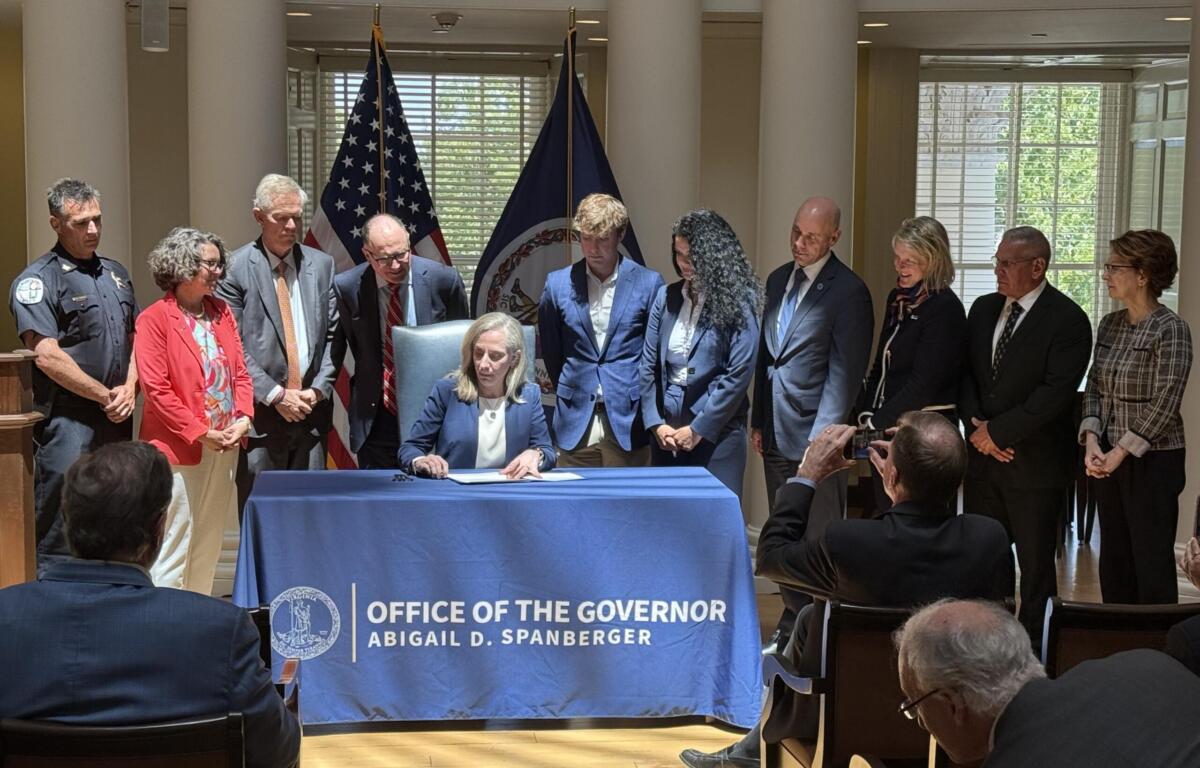

CHARLOTTESVILLE, VA (CVILLE RIGHT NOW) – Half a mile from the Culbreth Parking Garage, where three University of Virginia student athletes were shot and killed by a fellow student in 2022, Gov. Abigail Spanberger signed into law legislation aimed at curbing campus violence.
Spanberger signed SB272 and HB626 during a ceremony at UVA’s famed Rotunda on Tuesday, the first of two stops in the area.
Spanberger then went downtown to the Southern Environmental Law Center to sign solar and nuclear energy legislation.
“What I’m signing here today,” Spanberger said, “makes sure that campus safety personnel and campus police can act decisively in this commonsense legislation.”
Virginia has dealt with its share of campus shooting incidents in recent years, including the 2022 murder of Devin Chandler, Lavel Davis Jr. and D’Sean Perry.
That same year, a former student shot and killed a pair of police officers at Bridgewater College in Bridgewater.
Earlier this year, a shooter killed an ROTC instructor in a classroom at Old Dominion University in Norfolk. The victim, Lt. Col. Brandon A. Shah, was a 2002 Charlottesville High School graduate.
In 2007, a gunman killed 32 people on the Blacksburg campus of Virginia Tech, the deadliest school shooting in U.S. history.
Sen. Creigh Deeds sponsored the bill in the Senate, which narrowly passed it 21-19 on Feb. 9. Del. Katrina Callsen sponsored the House of Delegates version, which passed 63-35 on Feb. 5.
Both Deeds and Callsen were on hand for Tuesday’s signing at the Dome Room of the Rotunda, along with Del. Amy Laufer, University of Virginia President Scott Beardsley and Virginia Secretary of Public Safety and Homeland Security Stanley Meador, along with UVA football player Will Bettridge, a close friend of Perry’s.
The bill makes it so only law enforcement officers, ROTC cadets, and U.S. military personnel are permitted to carry firearms at public institutions of higher education in Virginia starting on July 1.
“The General Assembly has passed this legislation time and time again, and finally we are ready to say ‘yes’ for this bill to be law,” Spanberger said.
UVA Police Chief Tim Longo began lobbying for this legislation shortly after the 2022 shootings.
“God forbid if we find ourselves in a similar situation in the future, we have more leverage,” Longo said.
Longo acknowledged it is impossible to know if the law would have prevented 2022’s tragedy, but said it will help keep the campus safer moving forward.
“I’m hopeful it will impact future opportunities for us to keep these Grounds safer for our students, our faculty, and our staff, and for the parents who entrusted to us that which they love most,” he said.
“Today is a wonderful day, we have been working on this legislation for four years now, we crafted it in response to what happened at UVA, and now we have finally taken a meaningful step so that guns stay off our college campuses,” Callsen said.
Senator Deeds said, “We have a responsibility to parents to keep their kids safe, we have a responsibility to the young people, to other students, to keep them all safe.”
Following the ceremony at the Rotunda, the Governor motored downtown to Apex Plaza on Garrett Street to the headquarters of the Southern Environmental Law Center to sign legislation designed to make solar energy more affordable for consumers, and allow nuclear to count toward a power company’s clean energy goals.
The nuclear recognition bill is chief patroned by Deeds, and it “revises the conditions under which accelerated clean energy buyers, defined in existing law as accelerated renewable energy buyers, may contract with Appalachian Power or Dominion Energy Virginia to obtain renewable energy certificates (RECs).”
Deeds said, “We took out the term ‘renewable’ and replaced it with ‘non-carbon producing,’ so we are including nuclear power and fusion power in the Clean Economy Act. That’s going to mean we not only keep the Clean Economy Act working, but we have a better chance of producing not only reliable affordable energy, but cleaner energy.”
There has historically been reluctance to include nuclear power toward clean energy goals because of the waste.
“There are huge questions about nuclear power with what do you do with the waste. and you can’t say that nuclear power is without risk,” Deeds said. “But the risks are not as great as not having energy. People expect the lights to go on when they throw the switch. and giving nuclear power credit under the Clean Economy Act gives us a better shot of actually keeping the Clean Economy Act in affect. and also providing reliable and affordable and clean energy.”
The Governor also signed four bills sponsored by Senate Leader Scott Surovell designed to make solar energy more affordable.
One of the bills creates a statewide online permitting platform so homeowners can get rooftop solar approved faster and less costly.
Another bill facilitates what are called “shared solar programs” in Dominion Energy Virginia and Appalachian Power-served regions as the Virginia Department of Energy notes “nearly 50% of households and businesses are unable to host rooftop solar systems”.
They can join a community solar project as a subscriber.
Another Surovell bill the Governor signed removes obstacles for localities to impose on portable solar generation devices.
“I feel like the dam has really broken in Virginia when it comes to solar energy and clean energy, and we have a really big backlog of need for energy on our grid and I feel solar is the fastest kind of get out that and get deployed, and it’s also the cheapest kind of energy,” Surovell said. “So, if you don’t have the capital to put solar panels on your roof you’ll be able to sign up with this company and power your home with solar, or you’ll be able to go out and buy a solar panel and hang it off the side of your house, your trailer, your apartment, and plug it into your house and save money immediately.”
Some of the energy legislation is effective July 1 and some is effective January 1.