


 Listen Live
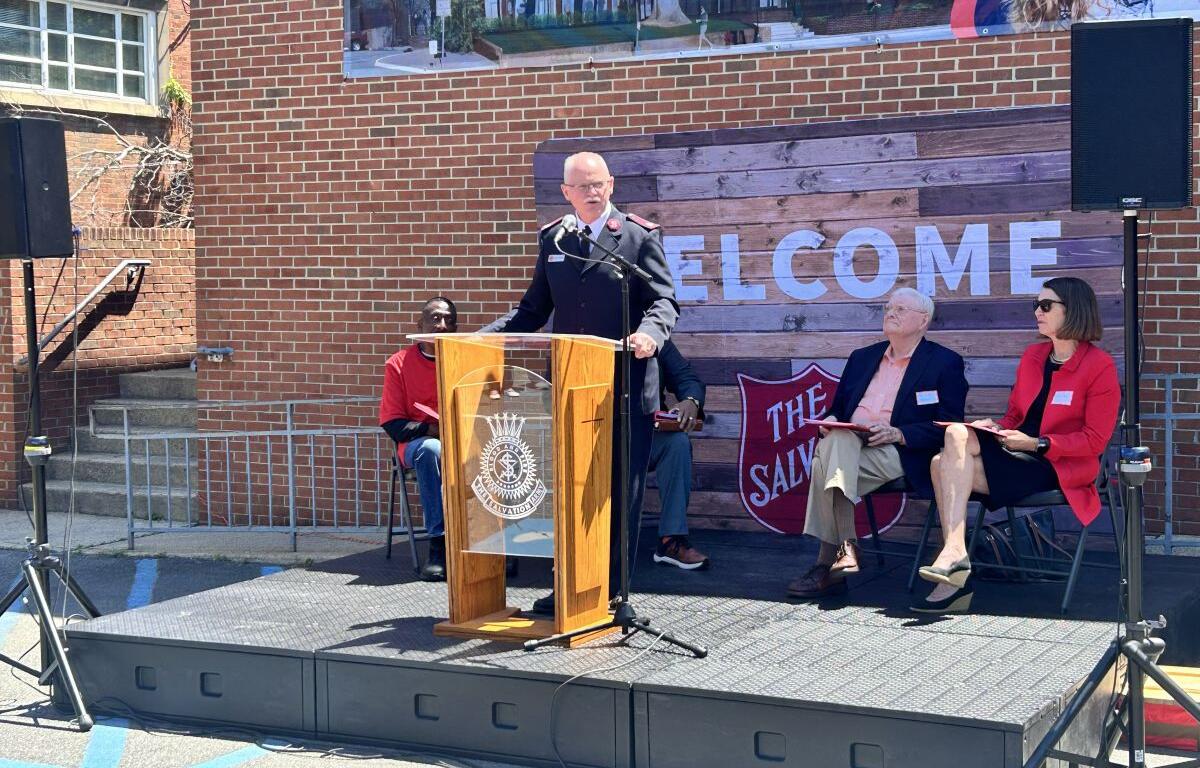

CHARLOTTESVILLE, VA. (CVILLE RIGHT NOW) — Salvation Army and local officials were on hand at the current home of the Salvation Army of Charlottesville on Tuesday, a site the organization’s local leaders are hoping to replace with the brand new 47,000 square foot “Center of Hope.”
To do that, the Salvation Army launched the public portion of the “Hope Has A Place” capital campaign at Tuesday’s event, with the goal of raising $28 million toward the construction of the new center. The Salvation Army has already raised $17 million, but the remaining $11 million is still a steep number for the organization.
“That is great news, but we have quite aways to go,” board member Richard Nunley said in his remarks at the event. “And it needs all of us to get in and pitch and do our best to raise this money so we can have this outstanding facility for our community.”
Maj. Donald Wilson of the Salvation Army of Charlottesville told Cville Right Now the plans for the new center have been in the works for almost 10 years. The current site’s three structures, built between 1969 and the early ’80s, includes 55 beds for men and women, and is the only emergency shelter for men and women in the county.
But what Wilson said makes the Salvation Army different is its commitment to work with people for extended periods of time, helping them out of homelessness
“They have to have a desire to do it, and a lot of folks do,” he said. “It’s just [they] don’t have the support mechanism, or the people who walk with them through these items.”
Once built, the new center will allow for the Salvation Army to help even more people. The center will double the capacity of beds from 55 to 110 while also moving from a “congregational” shelter to private four-person pods for increased safety.
The center will also double the capacity of the dining facility, allowing it to serve 120 people at a time and increase family accommodations, providing seven two-bedroom apartments for 28 total occupants.
The potential of the center and current impact of the Salvation Army were both central focuses of Tuesday’s event. Among the speakers, which also included Wilson, Nunley Chair of the Advisory Board Locke Ogens and Charlottesville Mayor Juandiego Wade, was Jerry Morrison, a Charlottesville resident who was assisted by the Salvation Army.
He arrived at the facility after being incarcerated for 14 months. He had nowhere else to turn to, but now he works three jobs and is 22 months sober after struggling with an addiction to alcohol since he was a teenager.
“It’s all about community,” Morrison said of the Salvation Army afterward to the media. “They will help you. They care about the community.”
Morrison said what excites him the most about the plans for the new center is its potential to help even more people.
Officials from both the Salvation Army and around Charlottesville also made it clear that extra space is needed, especially considering the prominence of homelessness in Charlottesville.
“If I could put it on a scale of 1-10, I say 10. It’s definitely needed,” Pastor Wendy Cooper of the Pilgrim Baptist Church, which frequently volunteers with the Salvation Army, told Cville Right Now. “It’s evident that it’s needed. And even the amazing facility they have now, we have outgrown, because the landscape in Charlottesville has changed.”
The city itself has contributed $3 million toward the center, with the mayor sharing in his remarks his experiences volunteering with the Salvation Army for many years before taking office.
“We need the work of the Salvation Army to partner with use as we try to address the unhoused issue in Charlottesville,” he said.
He added that on any given night, the city could have 220 people with a place to sleep, and the Center of Hope, as well as the upcoming low-barrier shelter on Holiday Dr., are both needed to address the issue.
State Senator Criegh Deeds (D-Charlottesville) and Del. Katrina Callsen (D-Charlottesville) were also in attendance at the event.
Wilson said the best way to support the campaign for the center is to make a pledge to the campaign, as that will help the Salvation Army determine how much it can do “right here and right now.”
“If they make a pledge, it can be over a five-year period of time and give us, they have resources,” he said. “But we really need them to do that right now, because as we wait, the longer we wait, the cost will always go up.”