


 Listen Live
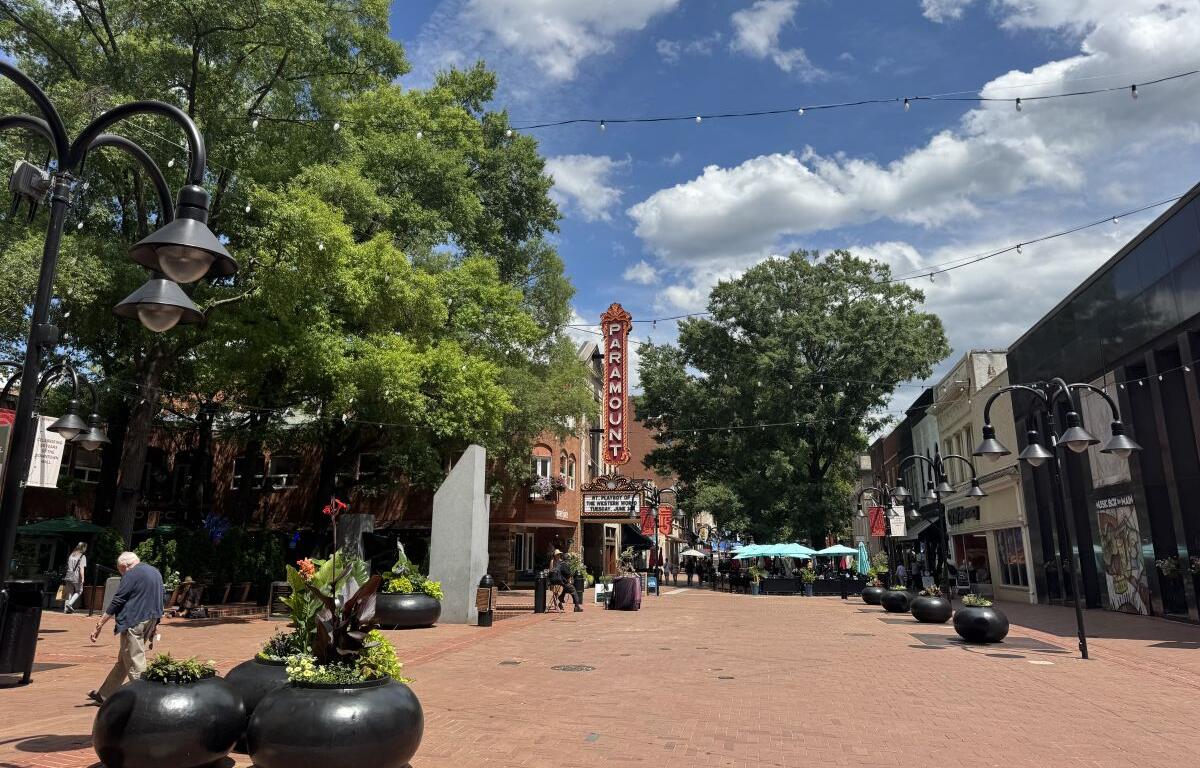

(EDITOR’S NOTE: This story is part of a series celebrating the people, places and history of Charlottesville’s Downtown Mall as it turns 50 this year.)
CHARLOTTESVILLE, VA (CVILLE RIGHT NOW) – As its 50th anniversary approaches, Charlottesville’s Downtown Mall has taken on a life of its own as a hub for dining, arts and culture.
However, half a century is only a short chapter in the broader history of the Main Street area, which has evolved from a site around the former Monacan trail of Three Notch’d Road and into an integral part of the city.
Olivia Brown, the Executive Director of the Albemarle Charlottesville Historical Society, said the site where the mall was dedicated on July 3, 1976 can trace its roots to some of the oldest history of the city and Albemarle County.
Brown noted that the original county seat of Albemarle County was in Scottsville, starting in 1744, and moved less than 20 years later to Charlottesville. The trail and the Rivanna and James River offered access and transport to the new city, which as technology progressed, would become more and more interconnected with the state, as Brown said.
“Having the Three Notch’d trail and the Three Notch’d Road come through this area contributed to its central nature,” Brown said. “Eventually, you’ve got road, railroad and river all in one place and that is what really helps Charlottesville to develop in the way that it does.”
Centuries later, a historical marker stands at one the end of the mall, and although its placement has less historical accuracy, it is positioned to inform interested community members on the city’s origins.
“The Three Notch’d Road marker is on the mall, but it could be a million other places, too,” Brown said. “Having it in this foot traffic heavy area actually probably allows for people to learn about it more than possibly if it were on a roadside.”
From that road eventually sprung Main Street, which went from horse-drawn wagons to a trolley car to automobiles. The mall project was launched later in 1974, over objections from many businesses and residents.
“The way that Main Street develops is very much in reaction to technological changes,” Brown said. “A lot of the small businesses were concerned that a huge project like that is going to tear up the road right in front of their business.”
The razing of Vinegar Hill, a predominantly Black neighborhood that was bulldozed in 1960 under a federal urban renewal program, also had an impact on the layout of the mall. Brown stated that even though the mall was not constructed as a part of this urban renewal initiative, or because Vinegar Hill had been razed, had the neighborhood been left intact, the mall would have developed differently.
For the first few years after the mall’s dedication – a project that was part of many nationwide to revitalize downtown spaces – some fears of lost business and more abandoned urban space seemed to be coming true. The opening of the indoor Fashion Square Mall in 1980, now defunct, proved competitive and the Downtown Mall initially struggled to find success. But as time went on and the mall became a site for outdoor dining, cultural events and a gathering space, it gained traction.
But beyond the business awnings and visitors, the mall is known for a few smaller and well-loved attractions that showcase its history and spirit, from flagship sites to hidden gems.
Paramount Theatre marquee and blade sign
The Paramount Theatre, built in 1931, has high status as one of the older and more ornate buildings on the mall, hosting over 300 events each year. Matthew Simon, the theatre’s director of operations and programming, oversees the facility and the many events it hosts annually.
“It’s got a lot of character and it needs a lot of attention,” Simon said. “The building itself is the Paramount’s number one asset, without that, we wouldn’t be where we are.”
A restoration project in the 1990s gave new life to original parts of the building, such as the water fountain – called a bubbler – the silk tapestries that hang in the auditorium, and part of the chandeliers, which have been partially reconstructed.
The seating has been revamped and the marquee lit up again once more in 2004. But the blade sign was left out of the renovation project, sparking another campaign to bring it back to life. In 2013, that project began and the 550 light bulbs on the blade sign – 1500 total when combined with those of the marquee – were lit again.
Beyond advertising events, the sign now shouts out engagements, graduations and more, a sight that prompts visitors to take out their cameras.
“It’s got to be the second most photographed thing in Charlottesville behind the Rotunda,” Simon said.
Storefronts
A few storefronts on the mall also predate the pedestrian space, with spots like Timberlake’s Drug Store, the Jefferson Theater and The Nook being part of the fabric of the city’s business landscape for generations.
Timberlake’s, a white building with detailed ironwork, advertises a soda fountain and deli in the window, one of many vintage offerings dating back to its opening in 1890. The lunch counter of Charlottesville’s longest-running eatery is still open and their prescription delivery service has been going strong since 1917.
“Timberlake’s has been in that location way longer than the mall has been where it is,” Brown said. “Some of those institutions are what kind of bring that continuity to the space.”
The Jefferson Theater, which was originally built as a bank in 1902, opened its doors in 1912. The Jefferson often hosted silent films, live performances and vaudeville.
The theater’s Greek revival facade and detailed archways were restored, along with its facilities, in November 2009, with a new balcony, two bars and new restrooms being built. Today, it hosts a wide range of events, with all kinds of musical acts playing there throughout the year.
Opened in 1951, The Nook is a staple diner with an exterior that still channels its mid-century roots. With tempered glass and an awning reminiscent of a theater, The Nook’s checkered floors keep its vintage looks going on the inside.
But one of its other notable features, an outdoor dining patio that many other restaurants on the mall also have, was an unexpected addition to the space. According to Brown, these outdoor restaurant spaces were not part of architect Lawrence Halprin’s original vision, but are now an integral part of the mall’s aesthetic.
“It wasn’t really planned to have all these restaurants take up the middle portion,” Brown said. But as Charlottesville became more and more of a food destination, with the mall becoming a hotspot for new restaurants and bars, the rise of patio spaces was a natural consequence.
The Virginia Discovery Museum’s Carousel
Installed in 2006, the Virginia Discovery Museum’s carousel has offered free rides to hundreds of thousands of children in Charlottesville. Its horses were cast in 1910 and the ride was donated by Fred W. Scott Jr., making it one of the oldest self-propelled carousels in the United States.
Restored in 2022 by the museum, outgoing board chair Jennifer Eberline remarked on the six-month long project to bring the carousel back to its former glory after almost two decades of being well-loved by local kids. In conducting outreach to sponsors and businesses to help fund the project, Eberline noticed the carousel still held a place in the hearts of Charlottesville parents and natives.
“That kind of carousel doesn’t really exist anymore,” Eberline said. “I think it reawakened a lot of people’s memories about their young children riding the carousel, or they themselves riding the carousel as a kid… I saw it as this anchor on the Downtown Mall for just fun and amusement.”
The museum worked closely with Scott Jr. to understand the background of the horses and navigate the painting process, bringing the awning back to life and restoring each of the horses with the help of Martin Horn, Inc. and artist Christy Baker of greenyellowblue.
Like many others, the carousel had served as the impetus for her to explore the museum in the first place and in completing the restoration — a ribbon cutting ceremony was held in 2022, with Scott Jr. doing the honors — Eberline experienced a full-circle moment.
“One of my earliest memories in interacting with the museum was my own children riding the carousel and then eventually (going) in the museum,” Eberline said. “There’s just something in our crazy day to day life that spinning around in a circle on a very simple device seems like a good type of slowness to enjoy.”
The First Amendment Monument
Dedicated in 2006 and remastered in 2026, the First Amendment Monument or “Free Speech Wall” stands in front of Charlottesville City Hall and celebrates the freedom of expression. Created by the Thomas Jefferson Center for the Protection of Free Expression, the wall is 54 feet long and a common gathering place for residents.
Chalk messages cover the length of the wall, with some words illegible, but the space is never empty.
Kristin Szakos, an activist with Indivisible Charlottesville, observed that the monument foregrounds a right some might take for granted and reminds the public of how fundamental it is for the city.
“Having that kind of reminder in the middle of our city is a good thing and it helps us fight harder for that right,” Szakos said. “We are constantly reminded that that it is important.”
The long and winding history of the Downtown Mall, with some of its parts relatively recent and others older than the United States’ founding, is a microcosm of the technological change and social progress that have transformed the city of Charlottesville and America at large.
The mall has carried different meanings over the last 50 years, from hopes of community connection to fallout over urban renewal. But even a half-century later it remains a relevant and multifaceted space for all.
Read the rest of Cville Right Now’s series on the Downtown Mall with these links:
Fridays After Five: 38 Years of the Downtown Mall Soundtrack
CPD Officer Matt Ryan reflects on one year of walking the Downtown Mall