


 Listen Live
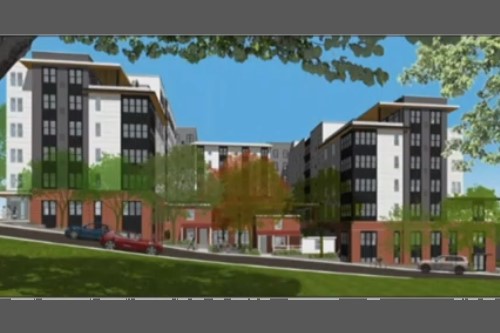

CHARLOTTESVILLE, VA (CVILLE RIGHT NOW) – City Council overturned the Board of Architectural Review’s denial of a Certificate of Appropriateness for The Mark high-rise project at the edge of Fifeville and approved an amended plan, voting 3-2 to greenlight the project Monday night.
The developer is seeking to build a high-rise apartment building on parcels of land at 202, 204, 208, and 214 7th Street, SW, and 613 Delevan Street. Two protected properties fall in the project’s scope, causing the certification question.
Councilor Lloyd Snook was among the three votes in favor of the project. He cited two reasons. The first was the overarching need for more housing in the city, noting the council’s new zoning ordinance was designed to encourage developments like The Mark.
“We have to keep just in the background the realization that Charlottesville needs more housing, period,” Snook said. “Not just affordable housing. More housing, period.”
Snook also said the technical legal issue at question was whether or not the developers, by agreeing to renovate the two protected properties on the land it would be developing, brought the entire project under BAR’s purview. He does not believe that’s the case.
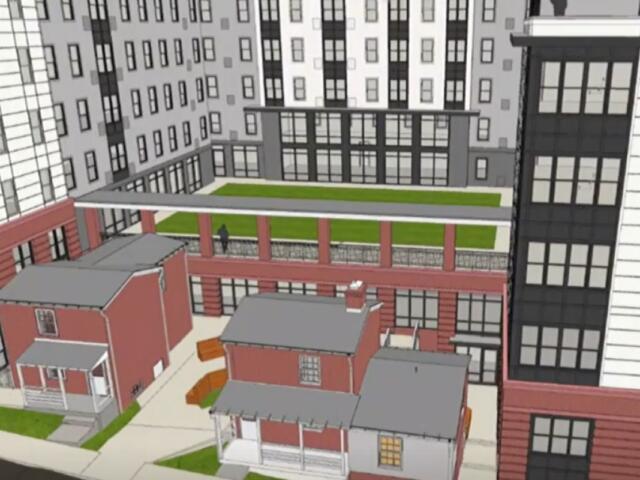
The developer has agreed to restore and renovate the two older houses, Snook said, and incorporate them into the plan for the Mark.
“These two small houses are falling down,” Snook said. “They haven’t been occupied for 20 or 30 years. They haven’t been maintained for 20 or 30 years.”
Snook said estimates for renovating the buildings on their own ran as high as $2 million, so the developer agreeing to do that work throws a lifeline to the two protected sites.
“These folks coming in were willing to do that because they want the rest of the land,” Snook said.
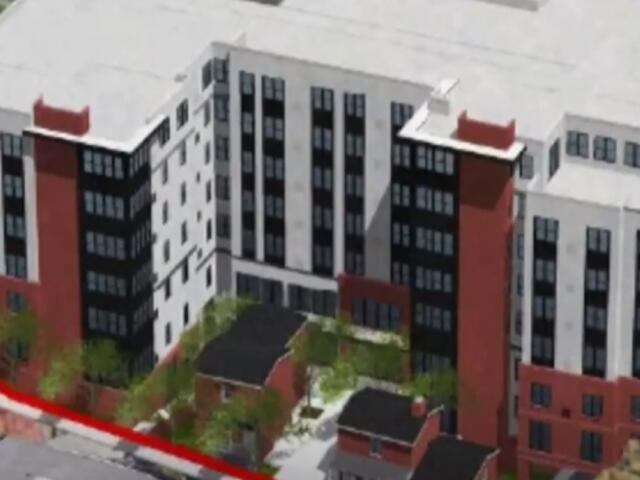
BAR Chair James Zehmer told Council they had three pre-application reviews and one Certificate of Appropriateness meeting, and he confirmed with city staff that while the IPPs were the reason the matter was referred to them, the entire project was subject to their review.
“That’s why we had all those conversations and deliberations about the entire project, which the appellant was part of those conversations,” Zehmer said.
Thus, Zehmer said they were charged with evaluating the project in the context of two small, two-story worker cottages from the late 19th century.
“One intent of establishing IPPs and reviewing projects related to them is to ensure that additions, alterations, restorations, landscaping and related elements be in harmony with a building or structure and its setting,” Zehmer said.
“At each and every meeting, BAR members expressed concern about the building’s height, scale, and massing,” he added. “The simple truth is a 180-unit, 770-bed, 7-story building is not compatible with two, one room-deep, two-story buildings.”
Thus the BAR denied the CoA not just because the proposed building encroached on the 204 and 208 7th property parcels, but because of the “height, scale, and massing”.
Nevertheless, Council voted 3-2 both to overturn the BAR decision, and to approve the CofA.
Council did so after the developer, Landmark Properties, agreed to move the building back about 70 feet away from the two IPPs and further reduce some heights near those properties.
They also reduced the height of the main building, though maintaining seven stories, and setback a little farther of Delvan.
Valerie Long, representing the appellant, said that resulted in a reduction of about 30 beds.
BAR vice chair David Timmerman shared concern with what commissions like the Board of Architectural Review are commissioned to do as being incompatible with the new zoning ordinance.
The properties in these parcels in this part of Fifeville are zoned “Residential Mixed Use 5” which allows buildings up to seven stories if affordable units are designated.
However, the city has less stringent requirements for student housing as this project, with that many beds in that few of units, is designed.
“A common question we often ask in determining if a project is acceptable or appropriate is ‘How does this project relate to the size and scale of its surroundings?'” Timmerman said. “The answer in this case is simple; it does not when you compare a seven-story building to the two small houses designated as IPPs located within the historic single-family Fifeville neighborhood. On the other hand, the only reason this project is under BAR review is because the two historic houses in question are designated as IPPs, and the developer willingly chose to include these houses into their development with the good intention of including them.
“Please take a moment to process the paradox we were presented with here: does the BAR simply ignore the guidelines set in place to protect our city’s historic fabric setting a precedent moving forward, or do we work to uphold the guidelines but do so at the worst possible cost which in this case is losing the IPPs? It should be clear that the fundamental issue here, and the reason our review was so difficult, is that the BAR guidelines are no longer aligned with aspects of the city’s new zoning ordinance given its recent drastic change.”
He surmised that maybe it’s a good thing this appeal was brought before Council, “So you might witness the friction when occurring when these new sanctioned projects run up against the city’s historic sensitive areas.”