


 Listen Live
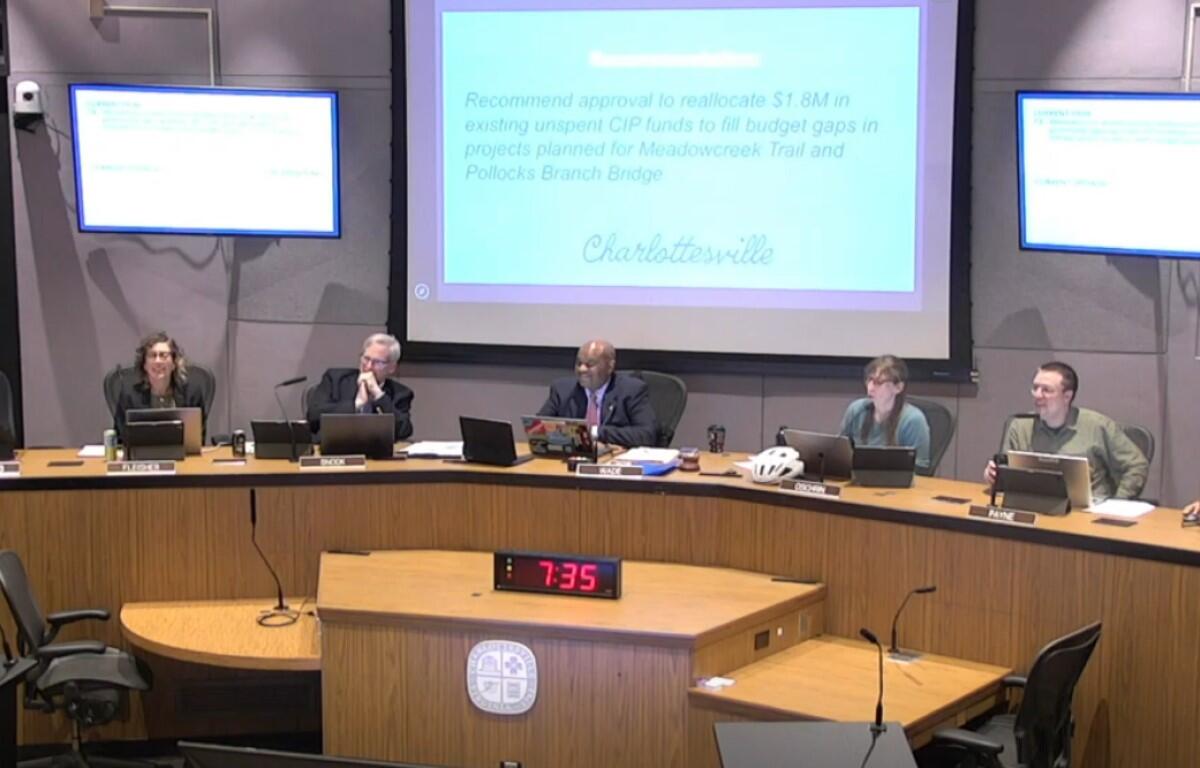

CHARLOTTESVILLE, VA (CVILLE RIGHT NOW) – Charlottesville City Council will hear a State of Homelessness Report during the afternoon session of its Monday regular meeting.
It’s a subject that has consumed a lot of time and consideration since homeless people who had begun pitching tents and camping at Market Street Park in late summer 2023 were cleared by a curfew instituted by City Manager Sam Sanders that enforced the park closing hours from 11 p.m. to 6 a.m.
Since then, advocates for the unhoused have pressed the city, and city leaders are responding, to what Sanders has acknowledged are inadequate housing and services for the area’s homeless.
With the city purchase of property at Avon and Levy for possibly some sort of homeless services back in February 2024, the examination of the Salvation Army thrift store at 604 Cherry Avenue as a suitable low-barrier shelter space which the organization offered in 2024, to the purchase late last year of 2000 Holiday Drive where the city will implement a low-barrier shelter facility, homeless services have consumed a lot of city leaders’ time and energy.
Back in September, Sanders offered his own report on progress saying, “It will take all of us.”
He offered a detailed progress report on the efforts over the prior two years attempting to improve the situation of unhoused in the city, and noted a number of properties and options they’re looking at to provide the needed services.
He provided a timeline which can be accessed on the City Manager’s portion of the city website.
“This is the entire city’s problem. We must address it. It’s not the people that is the problem, it is what we have to focus on to address their needs,” Sanders said.
In fact, he said he’s mentioned to surrounding county leaders that homelessness is the top city priority, but it is not only the city’s problem. County leaders have been active in some of the efforts Sanders outlined Monday night.
He mentioned an effort with Charlottesville Redevelopment and Housing Association Director John Sales about possibly using some vacant CRHA properties for possible temporary shelter and emergency housing options. Calling it a “tiny village” concept, Sanders said this will also require a case management partnership with a homeless services provider.
That report happened before the Holiday Drive property was put up for sale, and city leaders across-the-board acted quickly to put a successful proposal together in late 2025 to purchase it.
The city has been working with a working group involving the Blue Ridge Area Coalition for the Homeless, the Haven, People And Congregations Engaged in Ministry, as well as the Salvation Army for what they can do although they cannot offer a low-barrier sheltering opportunity.
“The biggest challenge is first determining what is the operational model,” City Manager Sam Sanders told Cville Right Now back in January. “There’s so many different aspects of attacking the problem of homelessness. How many different ways are we going to try to address homelessness in this one space?”
“We’re trying to reach everyone. In an attempt to reach everyone, then you’ve got to make sure that you have a lane that’s available for all that are out there,” Sanders said. “Because some folks are going to be easy to work with and others might be a little challenging to work with and their situations are even harder to work with. So you want to be able to say that there’s a place for you.”
That was at the time the city, and many of those in that working group coalition, were working with people in an encampment that had set up under Free Bridge during the huge “snowcrete” storm and frigid weather that followed.
He described barriers toward bringing people in from the cold being things such as storage of their belongings that they cannot bring into a shelter, as well as pets many have and how they can be accommodated.
The Council agenda does not say who will present the State of Homelessness Report.
Another literally “large” issue to be considered by Council is appeal of Board of Architectural Review denial of a Certificate of Appropriateness for a seven-story development in the Fifeville neighborhood called The Mark.
The policy briefing describes the project filed preliminarily with the BAR last spring as “a potential development at 202, 204, 208, and 214 7th Street, SW, and 613 Delevan Street”.
Last year, LCD Acquisitions in its BAR review noted they were seeking “to build new student housing, in full compliance with the City’s new Development Code on three contiguous parcels, 202, 204 and 208 7th Street SW.”
The properties are zoned “Residential Mixed Use 5” which allows buildings up to seven stories if affordable units are designated.
However, the city has less stringent requirements for student housing.
What the BAR has a problem with is the parcels include what are “Individually Protected Properties” (IPP) that City Council in 1991 made the status of some 80 properties.
According to the City’s briefing, ” Per City Code Chapter 34, Div. 5.2.7.A.1.a., a CoA is required for the exterior activities at an IPP associated with construction, reconstruction, alteration, or restoration of a building or structure. In addition to the Project-related rehabilitation of the two (2) IPPs, construction of the apartment building will encroach onto the two (2) IPPs; therefore, the entire Project is subject to design review and requires an approved CoA.”
“The IPP designation applies to the entire parcels at 204 and 208 7th Street, SW. The existing brick dwellings are contributing structures on those IPP parcels,” the briefing said.
The brick homes on 7th Street SW, according to city documents, are associated with James B. Hawkins who constructed them between 1876 and 1889 and are preserved as “early examples of a form very common in the city at the turn of the century”, and 204 is more unusual being two stories tall as opposed to the others in the city mostly “frame construction”.
“City Staff responds that, during deliberations, the BAR cited specific concerns regarding the Project’s height, scale, and massing, and, through application of the design guidelines,
determined it was incompatible with the IPP,” according to the briefing.
Mitchell-Matthews Architects is the appellant on behalf of the developer, according to the briefing, “argues that the BAR failed to identify specific elements it found incompatible with the
IPPs, that it considered impacts beyond the IPPs, and its decision undermined the height and density permitted by zoning”.
In addition, the BAR expanded public input on behalf of numerous citizens who turned out for the meeting last year, and the appellant argues “the BAR delegated decision-
making to the public”.
This item is for on Council’s 6:30 p.m. regular business session’s “action items”.