


 Listen Live
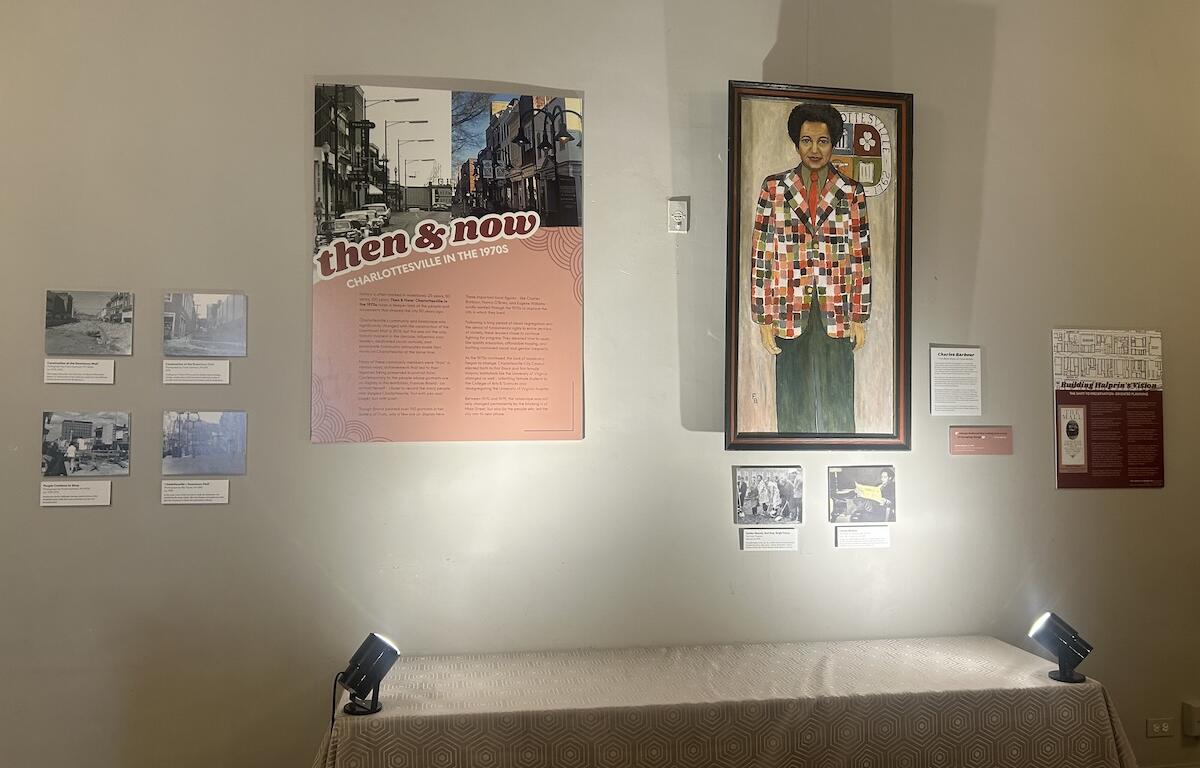

CHARLOTTESVILLE, VA. (CVILLE RIGHT NOW) — Tucked away in Vault Virginia on the Downtown Mall, a new exhibit from the Albemarle Charlottesville Historical Society explores the figures who shaped the city 50 years ago.
The exhibit, titled “Then & Now: Charlottesville in the 1970s,” is centered around 10 of the at least 157 portraits, all painted by local activist and artist Frances Brand, who passed away in 1990. The portraits, most of which were completed between 1974-78, each depict local figures who Brand believed were the first to achieve some type of accomplishment. Together, they make up the Gallery of “Firsts.”
“They were pioneers,” ACHS Executive Director Olivia Brown told Cville Right Now about the portraits’ subjects. “So, they were the first in their field to do something, or they were people who were really well-known in the community for certain reasons. And what’s great about it is that she was talking to and finding ordinary people who were doing really amazing things, and she wanted to highlight that through these portraits.”
The portraits selected for the “Then & Now” exhibit depict figures like Charles Barbour, Charlottesville’s first black mayor who served from 1974-76, Virginia Anne Scott, one of the four women who sued the University of Virginia in 1969 due to The College of Arts & Sciences barring entry to women leading to the university going fully co-ed, and Eugene Williams, who spearheaded the 1955 lawsuit that led to the integration of Charlottesville schools and founded the Dogwood Housing Alliance which led to more affordable housing.
Brand also made it a point to showcase a variety of races, classes, religions and professions in her gallery, and of the 157 portraits, 93 feature women.
Brown said Brand’s work not only involved painting the figures but having full interviews with them beforehand to learn who they were. These conversations informed how she painted them.
“The portraits always have stuff in the background,” Brown said, “and usually those are things that pertain to the work of the person that she painted, whether it’s something maybe they talked about in their interview, something that was relevant to them. and the work that they did.”
Brand’s portraits were donated to the ACHS by her granddaughter, and the organization has taken on the task of showcasing them to the public. In addition to the 10 featured in the “Then & Now” exhibit, there are an additional eight displayed in the lobby of the McIntire Building, the city’s first public library which now serves as the ACHS’ headquarters.
In addition, ACHS has also immortalized 51 of Brand’s 157 portraits in a book titled “Firsts: Volume 1.” The book also included biographical sketches on each of the portraits’ subjects. Brown said the hope is to produce three volumes, encapsulating the entire collection.
The exhibit has opened in the buildup to the Downtown Mall’s 50th Anniversary, with Friends of Charlottesville Downtown hosting a 50th Birthday Celebration on July 3, the day the mall was dedicated.
Brown said that anniversary was the impetus of the exhibit, as many of the portraits’ subjects played vital roles in the mall’s construction. The exhibit also features a number of photos of those subjects as well as the mall itself during its construction and early days.
“In this moment, 50 years ago, they were building the mall. They were constructing the mall,” Brown said. “And so we do look at the construction and development of the downtown mall as part of the exhibit too.”
The exhibit will be kept up at Vault Virginia through at least July, with Brown saying the hope is to keep it up through August as well. The ACHS is also planning special programming at the exhibit with Vault Virginia as well as Friends of Charlottesville Downtown.
Brown said the anniversary provides Charlottesville residents with an opportunity to learn more about the history of their area, while making valuable connections to what’s happening nowadays. She said in many ways, the conversations happening back then continue today, and learning about that history can “offer us moments to reflect on where we were and where we’re going.”
“A lot of what people are fighting for in social activism in the ’70s is better equality for women and people of color and representation for them in public resources, in government, in schools and education,” Brown said. “And these are all conversations that may have evolved over time, but they’re not ones that we have stopped having.”