


 Listen Live
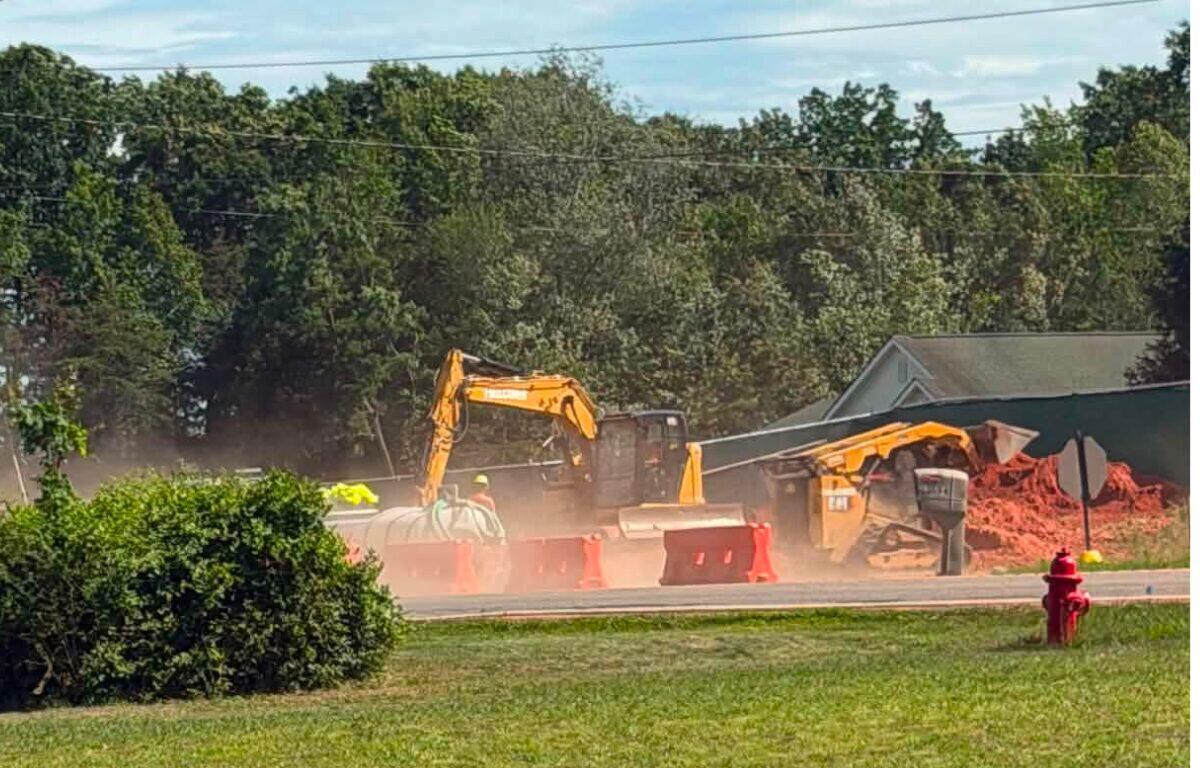

CHARLOTTESVILLE, VA (CVILLE RIGHT NOW) – Austin Newsom lives across the street from one of two major data center campuses, owned by Amazon World Services, currently under construction in Louisa County.
The first is being built in the Ferncliff area, and the second, the Northeast Creek Technology District, will sit along Route 33 near Lake Anna – adjacent to Newsom’s property.
Newsom told Cville Right Now that the data center’s construction has been a nightmare for him, both personally and professionally, for almost a year now.
“I was trying to sell my house and move on, but construction has made that impossible,” Newsom said. “Everything was caked in dust. It’s negatively affecting my business.”
Newsom runs a boat-servicing business out of his home and stores the boats he’s working on outside on his property. He said he never had any communication from the county or Amazon about the project during the zoning and development process.
Newsom said representatives of Clark Construction and Amazon called him to inform him just before work began.
Newsom said the water in the area turned brown because of the construction, and his property has been covered in dust and mud from construction. He reached out to both Louisa County and Clark Construction with grievances regarding the construction process and how it has affected his life over the course of the year.
Clark Construction declined to comment for this story.
Situations like Newsom’s are part of the reason why the Piedmont Environmental Council is advocating for a pause in Virginia to reform the process of data center project approval and construction.
“We aren’t opposed to transmission lines or data centers in concept,” Senior Land Use Field Representative Robert McGinnis told Cville Right Now. “We think they should be paused because they have no plan on how to deal with power.”
Nonprofits like the PEC and the Free Enterprise Forum have examined the data center footprint locally, but many Virginians are unaware of the impact that the construction can have on neighborhoods.
The Louisa County Board of Supervisors has embraced data centers and the economic benefits they bring. The board has zoned the land in which both data centers will occupy as a Technology Overlay District, with the purpose of attracting the type of development Amazon is currently engaged in.
The board’s chairman, Supervisor Duane Adams of the Mineral District, said the goal is to shift the tax burden from local residents to external, commercial entities.
“We’re just starting to see the benefit,” Adams told Cville Right Now. “We’ve attracted 35 billion dollars in investment to Louisa County. I don’t (know) where we could find a smaller footprint and have that kind of investment. We have a goal of completely eliminating the personal property tax on residents in the next three years.”
Adams said the windfall will fund infrastructure in the county, including a new elementary school, without incurring long-term debt.
During the board’s April 27 meeting, the board approved a 15% rate decrease in the personal property tax rate.
Supervisor Toni Williams, of the Jackson District, outlined the board’s intention with their development strategy, directly linking the rate decrease to the revenue obtained by the county from the Amazon development and any future developments by companies looking to build in the area.
“We’ve been attracting data centers intentionally,” Williams said in the meeting. “The citizens should see something for that.”
Louisa worked with the Virginia Economic Development Agency to attract the data center projects. The centers represent new jobs and revenue for the localities.
The Technological Overlay District is zoned in a way that there are not expected to be any impacts on transportation infrastructure, nor significant impacts to residential areas, Neil Williamson of the Free Enterprise Forum told Cville Right Now.
While the economic boon of data center development has been well publicized, opponents worry about the environmental impact of the construction and the centers. Once running, the centers draw both power and water from the regional supply.
Most data centers are powered by large diesel generators that are running throughout large parts of a given day, even during weather events. The large fans required to run a facility’s cooling systems also require amounts of water that some localities are unable to provide.
Greene County Planning Director and Zoning Administrator Jim Frydl outlined that an adequate long-term water supply is one of several reasons why plans for its Tech Flex District have not progressed.
The PEC has been researching the correlation between transmission line construction and data center development.
Dominion Power’s construction of two different lines, one originating in Dooms stretching to Charlottesville, and the other from Charlottesville to Gordonsville, is intended to power 26 data centers in Culpepper and Louisa, according to the company’s filing with the Virginia State Corporation Commission. Dominion also has already purchased land around the North Anna power station, McGinnis said.
McGinnis also said that prospective companies are looking at on-site power generation, utilizing gas turbines to meet power needs. Though its creation was not explicitly linked to powering data centers, the construction of a second power plant in Fluvanna by Tenaska will create 1.5 gigawatts of power in the area.
Modelling done by the Southern Environmental Law Center predicts that two to three people from Charlottesville to Chesterfield will die prematurely per year for up to 30 years due to air quality impacts.
Tenaska has filed an air quality permit and is preparing to submit a water discharge application with the Virginia Department of Environmental Quality in preparation for construction of its second power plant in the area. The company will be beginning community outreach to answer questions on air quality and water usage at a later date.
In Albemarle County, updates to its existing ordinance did not proceed due in part due to pushback against larger installations, along with a desire to wait for state regulations coming from Richmond. The only permitted data centers within county limits are data banks constructed within existing structures.
“When you look at zoning regulations and provisions in Louisa, we’ve done a good job of balancing responsible economic development while protecting the environment, while the protecting the neighborhoods and the neighborhood,” Adams said. “I don’t think those two things are mutually exclusive at all.”
For Newsom, his advice to those facing data center construction near their property was simple
“Either move or do anything you can to stop it from happening,” he said.