


 Listen Live
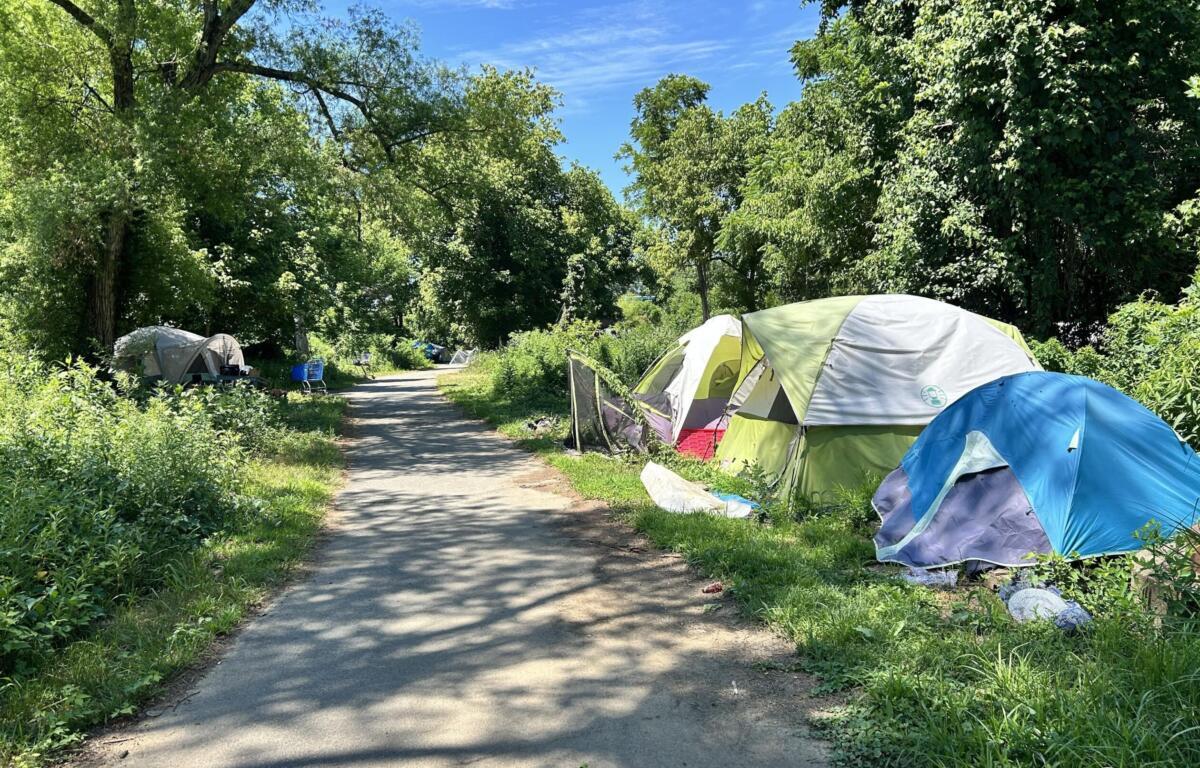

CHARLOTTESVILLE, VA (CVILLE RIGHT NOW) – As temperatures break into triple digits going into the Fourth of July weekend, concern for the health and safety of Albemarle County and Charlottesville’s unhoused population is also on the rise.
Shayla Washington, the executive director of the Blue Ridge Area Coalition for the Homeless (BRACH), said she hopes people will avail themselves of services like cooling centers that are being provided by both charitable organizations and local government.
“Don’t suffer out in the heat if you don’t have to,” Washington told Cville Right Now. “Seek out those services to stay cool and out of the heat.”
The National Weather Service is calling for “dangerous, record-breaking heat,” with local temperatures reaching as high as 104.
Cooling centers are operating at Key Recreation Center on East Market St., Tonsler Recreation Center on Cherry Ave., and at Central Library on East Market St., as well as The Haven, on West Market St.
Even without the heat, encampments like the one at Free Bridge can be unsafe for residents. Washington said the possibility of flash flooding from the Rivanna River and the presence of dangerous or disease spreading wildlife, including snakes and rats, present dangers. Now, with the extreme heat, living outdoors becomes even more untenable.
On Monday, a fire broke out at the site that required Charlottesville Fire Department to handle it. At least two people have been found dead at the encampment in the past eight months.
“I came from the Gulf Coast. I know what the heat can do,” Charlottesville City Manager Sam Sanders said. “It’s too hot to be outside for extended periods of time.”
Volunteers who work with the encampments told Cville Right Now residents have been going to public pools or dipping into the river to try to cool down, in addition to visiting cooling centers. Local charitable organizations, including the C’ville Care Bears, have visited the encampment passing out ice and water.
“It’s just incredibly dangerous,” Charlottesville Police Chief Michael Kochis said. “That coupled with the drought that we’ve had. It’s a very difficult situation down there, and I’m not sure it’s going to get better any time soon.”
Success during the winter freeze
When the region was hit with freezing temperatures, snow and ice in January and February, the efforts of the city and local non-profits to get people off the streets and indoors were apparently highly successful.
Washington said a Point In Time (PIT) study in January indicated that most of the accounted for unhoused population were in some type of shelter during the height of the dangerous winter weather. She said 101 unhoused people were in emergency shelters, 87 were in hotels and only seven were recorded as living outdoors.
Of those seven, four were in the city and three were in Louisa County, Washington said.
“We were able to put people in hotels because it was extreme cold,” Sanders said.
Collecting data
BRACH is planning a pair of studies to gauge the extent of homelessness in the area, information Sanders said will be invaluable both in planning an emergency measures this summer and in mapping out long-term solutions. There will be a new PIT headcount done July 22-23 to give the organization of how many people are currently sleeping outdoors.
There will also be a more extensive survey, focusing on the encampments at Free Bridge and 0 East High Street, that will run for about week and start July 20.
Sanders said that information will help inform the city’s plans moving forward.
BRACH is seeking volunteers to help conduct the PIT count and volunteers can register online.
Holiday Drive, but not for this holiday
Sanders said the city continues to examine opening the property it purchased on Holiday Drive as a temporary shelter, but noted that it’s not suited to house people – and may not be up to code in some areas – as a turnkey location.
He said there is an Aug. 31 deadline for an operating plan for a permanent, low-barrier shelter at that location.
“We’re working through that,” Sanders said.
Sanders also noted that the $7 million in the state budget that the city will receive is to double the capacity of the Salvation Army shelter, not for a new facility.
“It’s a big piece of the puzzle,” Sanders said of the Salvation Army’s Center of Hope facility.
Free Bridge encampment challenges
Sanders noted the city walks a fine line when it comes to helping people in the Free Bridge encampment, where about 80 unhoused people are living in tents near the Rivanna River.
He said the city can’t simply remove tents that appear to be unoccupied, because they could belong to someone who plans to return. He said patrolling the area to make sure no one is in medical distress is difficult, because police and fire staff don’t want to infringe on the privacy of people in tents.
“We’re down there almost every day,” Kochis said. “We’re doing significant outreach out there. We brought our Community Action down out there last week, talking to folks and continuing to do that important outreach out there.”