


 Listen Live
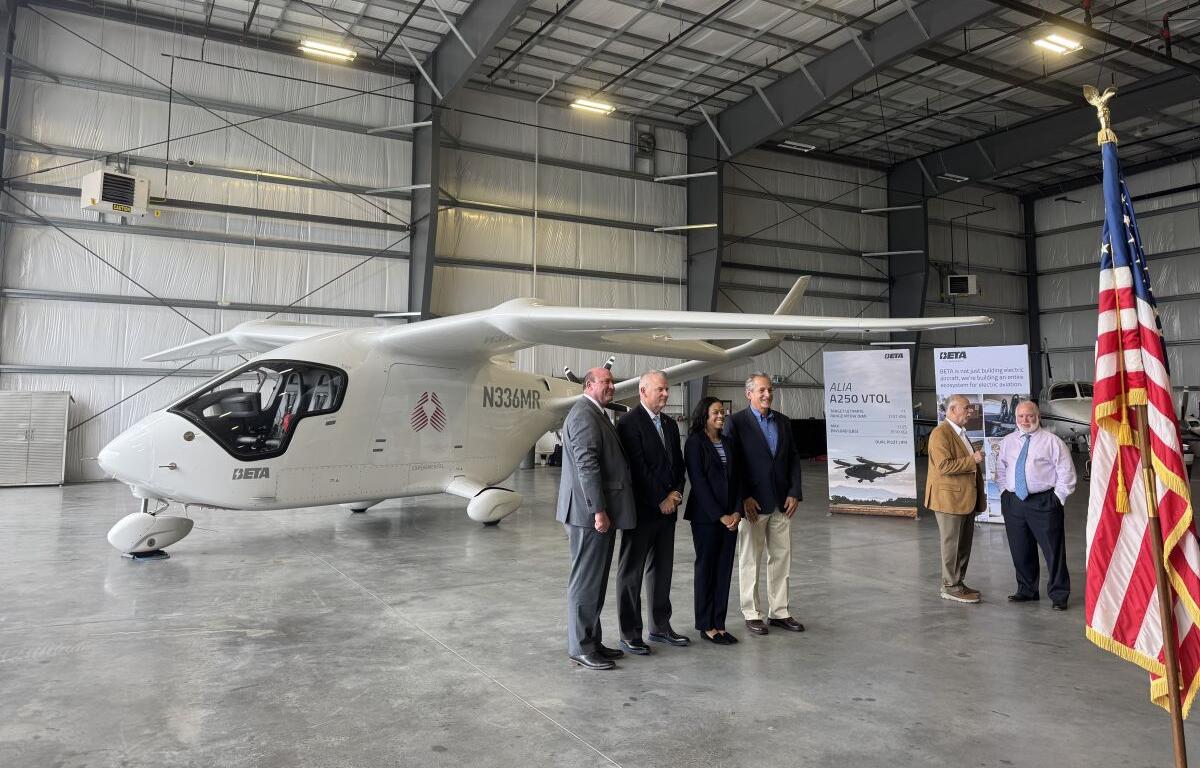

CHARLOTTESVILLE, VA (CVILLE RIGHT NOW) – The Charlottesville Albemarle Regional Airport hosted an event celebrating the first conventional takeoff and landing of electric aircraft conducted under the Federal Aviation Administration’s electric vertical takeoff and landing (eVTOL) Integration Pilot Program (eIPP).
A pair of eVTOL aircraft flew from Blacksburg to Charlottesville to Frederick, Md. to Baltimore County, Md. on Friday.
eVTOL aircraft are part of a broader new technology, Advanced Air Mobility (AAM) Aircraft, which can transport people and cargo in ways traditional aviation does not cover – nicknamed “air taxis”, these crafts are smaller and more energy efficient.
A part of the Multistate Collaborative eIPP National Integration Complex, a public and private partnership led by the Federal Aviation Administration, state aviation leaders and private partners, the eVTOL aircraft at CHO was manufactured by BETA Technologies, Inc. and intended to be used for transporting manufactured organs in collaboration with United Therapeutics Corporation.
The partnership intends to revolutionize organ delivery logistics, as well as show the capabilities of AAM aircraft and how they can improve sectors like healthcare.
“Our mission to manufacture an unlimited supply of transplantable hearts, kidneys, lungs and livers requires thousands of organ delivery flights per day,” said Martine Rothblatt, CEO of United Therapeutics. “Our FDA-approved clinical trials for the heart, kidney, and bridge-liver, and this month’s FDA approval of our lung device, show how quickly this mission is being achieved. Today’s flight demonstrates how public-private collaboration can accelerate air transport innovation and thus help enable millions of lives to be saved over the coming decades.”
Remarks were made by Jessica Jones, the FAA’s Executive Director of Advanced Aviation Technologies Office as well as State Aviation Directors from Virginia, Maryland and Pennsylvania and BETA CEO Kyle Clark.
“The FAA recognizes the importance of emerging technologies and see the critical role we must play in helping safely integrate them,” Jones said. “Today’s flight shows how AAMs can enable the rapid transport of medical supplies.”
The corridor connecting Pennsylvania, Virginia and Maryland is the inaugural site for this integration, with the two crafts covering 275 nautical miles and going between airports in Blacksburg and Charlottesville, Virginia and Frederick and Baltimore County, Maryland.
BETA was selected by the FAA and U.S. Department of Transportation for 7 out of 8 eIPP programs in March and Clark highlighted the energy efficiency of electric planes, which are more compact than traditional aircraft but battery-powered, with a range around 300 miles and charging in under an hour for around $13, according to the company. Although the aircraft could be used for delivery services for UPS and Amazon, the partnership with United Therapeutics gives the aircraft potential for a massive impact on organ transport.
“It allows us to utilize airports like Charlottesville at a much higher rate,” Clark said. “Thousands of airports across the country could be served by lower cost electric aviation.”
Clark argued that electric aircraft could help shift away from the centralized “hub-and-spoke” model of aviation where major “hub” airports connect smaller ones, as a disproportionate level of traffic in these hubs have increased costs, making organ, blood and medical device deliveries more difficult.
Airports like CHO also provide more access to rural areas or areas outside major cities, ultimately making healthcare deliveries more manageable across the country.