


 Listen Live

CHARLOTTESVILLE, VA (CVILLE RIGHT NOW) – Charlottesville City Manager Sam Sanders presented a 2027 general fund budget to City Council Monday night of more than $279-million, one that includes a two-cent increase on the real estate tax rate.
“That is necessary to balance all the things I just went through and being able to make those things happen and meet the priorities that were identified for us in this cycle,” Sanders told Council during Monday’s meeting.
The increase would bring the city’s real estate tax rate to $1-per-$100 assessed, assessed values up this year an average 4.27% on residential properties, 2.14% commercial, and 3.42% combined.
Sanders showed a slide during the presentation showing the Charlottesville area with among the highest home values on the Eastern Seaboard with an average home value of just under $549,000 in 2026.
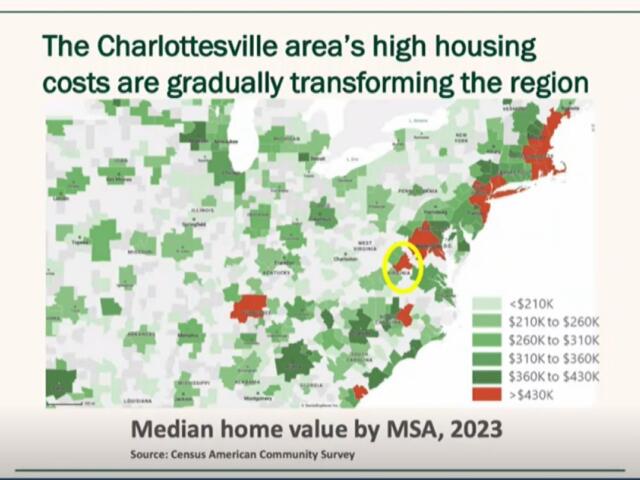
“That in itself speaks to the challenge that exists for those living in our community and trying to manage when things are that tight and that difficult,” Sanders said.
Sanders said he thinks of a budget about how we’re going to spend and save over a period of time, with savings an essential part “because there’s always going to be a rainy day and we have to plan for it”.
And he said it’s his responsibility under the city charter and state constitution to present a balanced budget which can be done in only two ways, increasing revenue, and/or decreasing expenses.
Sanders outlined priorities that he had to fund which is primarily based on “a commitment to community prosperity” for everyone.
“We have nine strategic outcomes areas which you all know I’ve had a weird relationship with this list of nine saying that it’s too many, too many, too many, but you’ve said it’s okay, Sam, you can get through that,” Sanders said.
Those nine priorities he listed are affordable housing; public safety; organizational excellence; transportation; climate action; partnerships; education; economic prosperity; and recreation, art, and culture.
He said he’s been able to check off organizational excellence and partnerships accomplished in a plan over the past three years.
The largest allocations of budget money, Sanders noted, are in transportation, affordable housing, and schools.
He notes in three community forums held last month in which attendees were given monopoly money to allocate over what were their priorities, the top-four were education, public safety, transportation, and housing.
The natural revenue growth without raising the tax rate from this year to next is about $11.9-million.
The two-cent real estate tax rate will add $2.4-million for a final revenue growth of $14.3-million.
The increased tax rate money, Sanders showed, is necessitated within those priorities for deeper transit investment, school local match funds, and collective bargain impacts.
Sanders’ proposal holds the line on a 9% lodging, 7% meals, and $4.40-per-$100 personal property tax rates.
The City Manager proposes committing $2.2-million in 2027 toward what is a four-year, $9-million-plus investment with counties to transform transit.
The city’s share over the four years is just over $6.1-million.
Sanders’ plan commits $2.5-million to the school system local match, a number the superintendent was able to bring down from an initial $6-million ask.
The bulk of that, $1.6-million, goes for collective bargaining compensation that includes a 5.5% salary and benefits increase for licensed personnel and 10.5% for support professionals.
The plan also commits $11.5-million toward affordable housing, which includes a $5-million final grant of three toward Westhaven redevelopment, $1.7-million toward Kindlewood Phase 3 and infrastructure improvements, $700,000 toward developing a commercial space in the 501 Cherry Avenue project, and a $227,000 interest payment in the acquisition of the Carlton Mobile Home Park.
The budget also pumps $1.5-million into the Charlottesville Affordable Housing Fund and HOPS, and $900,000 into the Charlottesville Supplemental Rental Assistance Program.
In addition to the general fund budget, the plan adds $129-million overall for the schools, $89-million in utility operations, $47-million in capital projects, and $18-million in debt service.
For employees benefits, Sanders calculated a total cost of $22.7-million in healthcare contribution, and $17.9-million toward the pension plan.
Unaffiliated workforce members are proposed for a 2% pay raise and 2% pay scale adjustment.
Those are employees not covered at this time by collective bargaining, which right now involved four city departments.
Under collective bargaining, fire personnel will get a 2.9% increase aligned with their anniversary date along with a 2% step increase.
Police personnel get 4% and 3% respectively, and CAT 3-to-5% pay scale increases according to position and a 2% step increase.
Public utilities, Parks & Recreation, Public Works and other miscellaneous personnel will get the 2%.
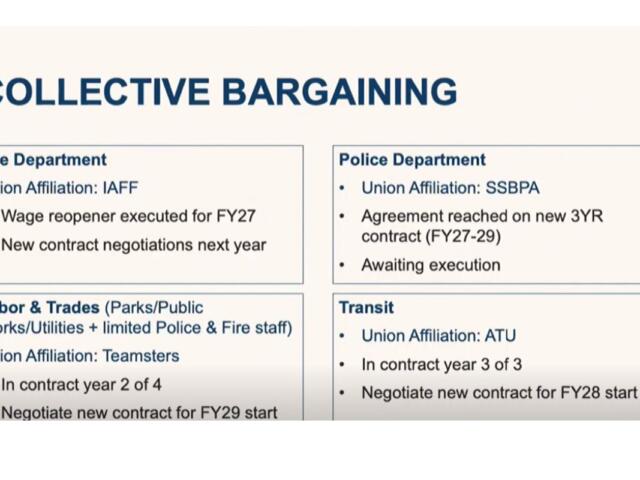
In regard to collective bargaining, Sanders said, “Having four contracts is quite a pickle you have put us in. Having us having this many contracts to manage, we’re in a perpetual state of negotiation, that is the reality,” Sanders said. “We finish one and we move to the next one and sometimes we have two at the same time. That is how we have to work, we’ve had to add additional staff and we’ve had to maintain outside help just to keep all the balls in the air.”
Sanders said the city stands to get in January a $21.8-million revenue sharing check from Albemarle County, $1.7-million more than last year.
There’s also still $600,000 left from the $19.6-million of ARPA funds the city received during the pandemic.
Sanders noted that has to be spent by December 31 or given back to the federal government, “And Sam doesn’t send money back to the federal government, so everybody’s been warned they must spend the money.”
He pointed out the city has been able to earn $1.9-million in interest off this money.
Finally, he said there’s the $10-million surplus from the 2026 budget, and part of the $22-million from the year before, “We’ve continued to have a surplus because the surplus we generated out of our last budget I’ve begged for us to hold onto those funds because we knew the Administration was changing in DC and we did not know what the volatility was going to bring to us, and I would venture to say we still don’t know.”
“We have started to use those funds as I came before you a couple of times this summer and came back and we spent a little over $6-million acquiring 2000 Holiday Drive.”
Sanders said, “I plan to come to you in the next meeting and spend a big chunk because there are a lot of things that still need to be addressed.”
Next up are budget workshops March 5 and 12, the 1st tax rate public hearing March 16 on an advertised real estate tax increase that cannot be more than two-cents, a community budget forum March 19, another work session March 26, a budget and tax rate public hearing April 6, and final budget adoption at a April 9 City Council meeting.