


 Listen Live

CHARLOTTESVILLE, VA (CVILLE RIGHT NOW) –Two women who came to Charlottesville through the International Rescue Committee will share their stories Friday as part of an event focused on the experiences of refugees in the community.
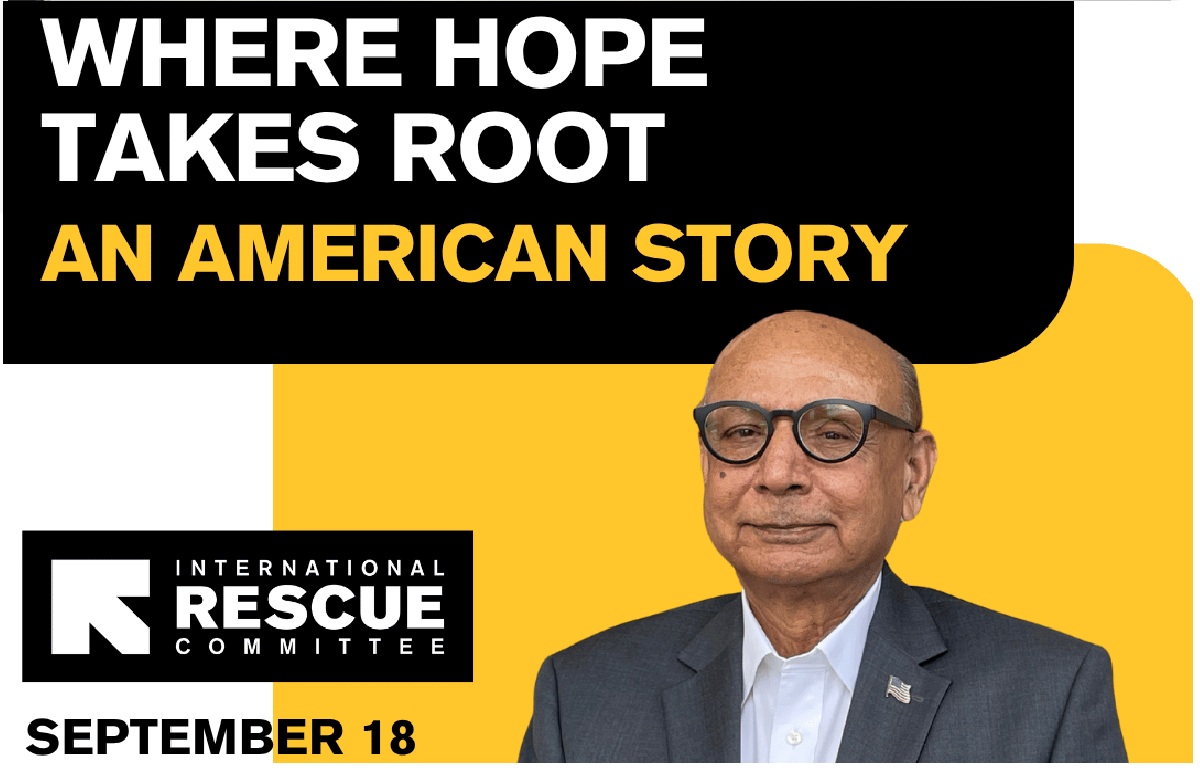
The International Rescue Committee’s Virginia office is presenting “Where Hope Takes Root: An American Story” at Vinegar Hill Theater.
The event, scheduled for 6:30-9 p.m. at 220 W. Market St., will feature the first public screening of a documentary-style film about two IRC clients, followed by a live question-and-answer session and a keynote address from Khizr Khan, a Gold Star parent, Presidential Medal of Freedom recipient and attorney admitted to practice before the U.S. Supreme Court.
John Elwell, community engagement manager for IRC Virginia, told Cville Right Now the event is an opportunity for people who have experienced resettlement firsthand to tell their own stories.
“And their story of resettlement, their story of immigration, is truly an American story,” Elwell said.
The 12–15-minute documentary, produced in partnership with Lighthouse Studios, features the stories of Dragana Katalina-Sun and Samman Akbarzada.
Katalina-Sun, one of the owners of Marco & Luca Dumplings, arrived in Charlottesville during the IRC’s early years. Elwell said she has since built her business, raised a family and become an established member of the community.
Akbarzada arrived more recently. She is a University of Virginia student, published poet and author.
The two women have very different experiences, and the documentary gives viewers a chance to hear those stories directly from them. Both will also participate in the live Q&A following the screening.
Elwell said that personal perspective is an important part of the film and the event.
“The work is important. The things that we do are very important, and they allow individuals and families to take those necessary steps for themselves. But it is the client story, it’s the lived experience that really matters,” Elwell said.
He said the stories featured in the documentary include difficult moments, as well as humor and inspiration.
“They have these incredible stories that are equal parts sad, equal parts funny, equal parts inspiring,” Elwell said.
The IRC has served Virginia for nearly 30 years. Its Charlottesville office opened in the late 1990s, and Elwell said it has helped resettle more than 5,000 people.
Over the years, people served by the IRC have arrived from a wide range of countries and crisis zones. Elwell noted that some of the organization’s earliest clients in Charlottesville came from Bosnia and other parts of the former Yugoslavia. More recently, the organization has worked with people arriving from Afghanistan, the Democratic Republic of the Congo and other areas affected by conflict and crisis.
Among those who have arrived in Charlottesville are people with Special Immigrant Visas, or SIVs. The program provides a pathway to the United States for people who worked with the U.S. government or military overseas and faced threats because of that service.
Elwell explained that Charlottesville’s proximity to Washington D.C. is important for some SIV recipients because of their previous relationships with U.S. government and military personnel.
“They have those pre-existing relationships with U.S. government officials, U.S. military officials, and that proximity to D.C. is very important for those individuals,” Elwell said.
The IRC helps newly arrived families with housing, school enrollment, health services, benefits, English-language learning and employment. It also offers interpreter services, financial coaching and assistance with establishing credit.
“The IRC provides an array of services kind of all geared toward helping people acclimate to their new communities, integrate into those communities, and then become self-sufficient,” Elwell said.
The organization also works with local businesses and community groups to help people connect with their new communities. Elwell said much of the initial support happens during the first 90 days after arrival, when there are urgent needs such as paperwork, documents and other requirements.
Khizr Khan’s story is also closely connected to the event.
Khan immigrated to the United States from Pakistan in 1980 and later earned a Master of Law degree from Harvard Law School. His son, U.S. Army Capt. Humayun Khan, was a UVA graduate and Army ROTC cadet who was killed in Iraq in 2004.
Khan received the Presidential Medal of Freedom in 2022, the nation’s highest civilian honor. He has also worked as an attorney and advocate and is admitted to practice before the U.S. Supreme Court.
Elwell said Khan’s story connects to the experiences of the immigrants and refugees featured in the documentary.
“The theme of the event (is) that these refugees and immigrants who come here and they become American and then they demonstrate the ideals of what it means to be an American,” Elwell said. “And the Khan family, you know, made the ultimate sacrifice for this country, and Mr. Khan has since become a renowned speaker. And he talks, he goes to communities and talks about compassion and community and constitutional rights and making sure that as a country we’re living up to the ideals that I think all of us believe the United States has.”
Elwell said the three people at the center of the event — Katalina-Sun, Akbarzada and Khan — each brings a different perspective.
After the film, Katalina-Sun and Akbarzada will participate in a live Q&A. They will have another opportunity to talk about their experiences and what they hope viewers take away from the documentary.
The event also serves as a fundraiser for IRC Virginia. Tickets are $60 for the event, film, Q&A and keynote. Full Admission tickets are $100 and include a reception following the program with complimentary food and drinks.
For Elwell, the event is about giving people an opportunity to hear directly from those who have gone through the resettlement process.
“The impact is just so much more when an individual can hear that from someone who has gone through it…” Elwell said. “When you allow people to tell their own story, that makes it harder to fear someone, (and) that makes it definitely harder to hate someone. It makes you feel more in common with them than you would otherwise.”