


 Listen Live

CHARLOTTESVILLE, VA (CVILLE RIGHT NOW) – Reuben Ealy deals with congestive heart failure, blood clots and fluid accumulation. The 46-year-old California native has spent much of the past two months in and out of UVA Health.
Adding to Ealy’s struggle? When he is discharged from the hospital, Ealy has no home to go to for his recovery. He is one of the hundreds of homeless people currently living in Charlottesville.
“I’m really nervous about it,” Ealy told Cville Right Now after his most recent discharge. “Not going to sugarcoat it.”
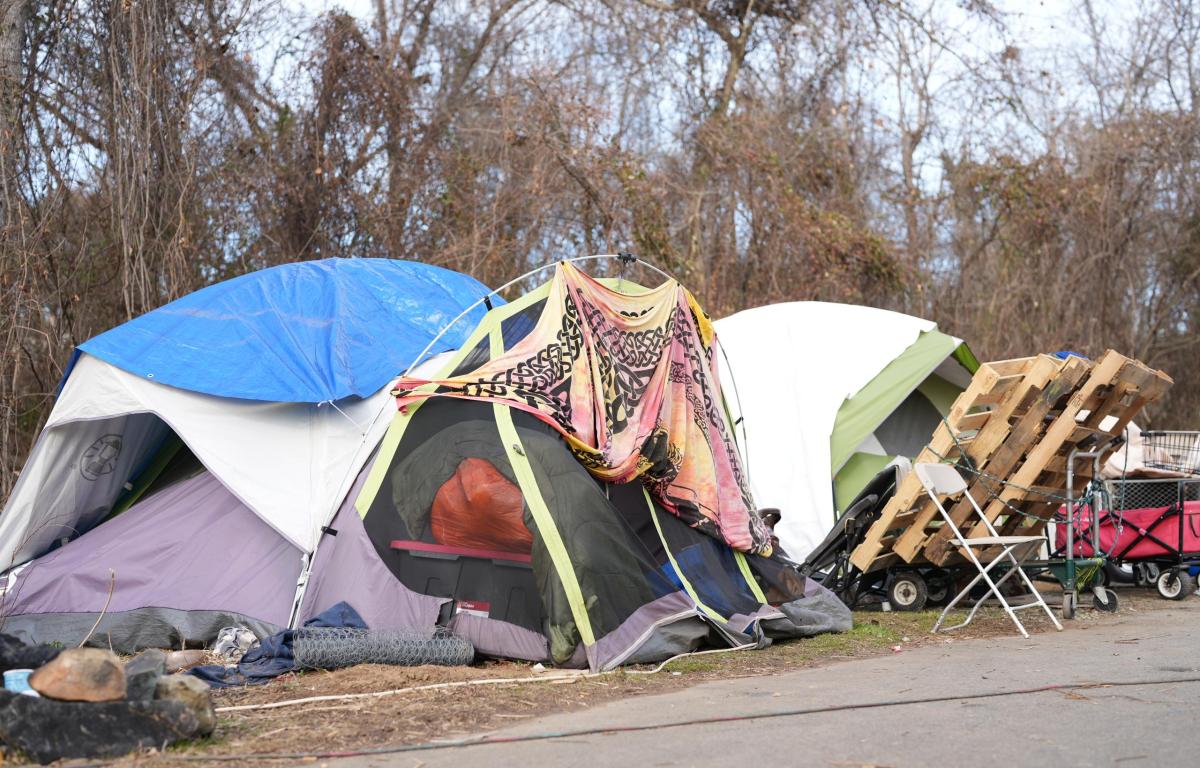
Ealy said he and his wife have been homeless for about two years now, since his health issues caused him to lose his job as a dishwasher and cook at Taco Bell. They live in a tent near the Food Lion on Route 29.
Last week, the Ealys had a week-hotel stay paid for by local non-profit workers. But by the end of the week, they were back on the street and back in the heat, a challenge for Ealy’s breathing.
“I’m terrified for him being out there,” Reuben’s wife, Wendy, told Cville Right Now. “He’s going to die out there.”
Reuben Ealy’s story is not a one-off. Around Charlottesville, unhoused people struggle to recover from illness and injury because, once their time in the hospital ends, they are back outside dealing with the elements.
The risk of infection from unsanitary conditions, exposure to the elements and extreme temperature make even basic recoveries challenging.
Most of the city’s current homeless shelters are considered high-barrier, meaning they have certain requirements to admit someone. Those requirements range from employment status to addiction and mental health issues.
Ealy said the Salvation Army shelter could not admit him because of his health and that, as an overnight shelter, he would still be outdoors during the summer’s intense heat.
30-year-old Kristina Napier was diagnosed with congestive heart failure two years ago. She said she only has 20% lung function. Napier, who said she has battled drug addiction for years, lives in a tent at the Free Bridge encampment.
Napier said, at one point, she spent two weeks in a coma. When she awoke, she had to relearn to speak and walk.
“It was definitely a battle,” Napier told Cville Right Now. “Being homeless too, it’s not particularly an ideal way of everyday life.”
Napier and Ealy said they’re frustrated that UVA Health has programs to provide hotel rooms for the family of out-of-town patients who are receiving treatment, but don’t offer the city’s homeless hotel rooms for recovery.
UVA’s Hospitality House is for family members traveling from at least 60 miles away to visit someone who is hospitalized, spokesperson Eric Swensen told Cville Right Now.
“For patients experiencing homelessness who are medically ready for discharge but have ongoing recovery needs, UVA Health can provide temporary lodging in some circumstances, typically when there is a specific, short-term need,” Swensen said. “For example, this could provide access to resources such as home health or palliative care services, while ensuring a dedicated contact is available to support next steps. We recognize that the needs of people experiencing homelessness are varied, complex and challenging to fully address through hospital-based programs.”
Swensen said UVA offers support through the Homeless Consult Service. In that program, a team meets with a patient during their hospital stay to assess their needs for “a stable discharge.” They also can help patients connect with other area non-profit services.
“The goal is to make a hospital stay a turning point, not a revolving door,” Swensen said.
But for Ealy and Napier, they say that’s exactly what’s happened.
Non-profits have stepped up to help, but their resources are limited.
The CareBears is a group that has worked to support the homeless encampment at Free Bridge. Members also aided both Ealy and Napier with finding temporary shelter following their hospitalizations.
According to a statement from the organization, to date in 2026, CareBears members have covered “well over a month’s worth of hotel rooms” for homeless people coming out of area hospitals.
“Many people are stuck in a vicious cycle of being discharged to the streets, just to end up back in critical condition, when that could be avoided by UVA putting them in hotel rooms, as they do for out-of-town patients who need it,” the statement read. “UVA has a medical hotel program in place for housed people from out of town and it is critical to the survival of our neighbors that they extend that program to those who are unhoused and in critical medical need here in Charlottesville. If UVA truly cared about meeting the medical needs of people they served, they would provide these hotel rooms. The fact that this falls to a group of community volunteers exposes a hole in the system that UVA needs to fix.”
Charlottesville has a number of projects in the works aimed at supporting the city’s unhoused population. A low-barrier shelter at 2000 Holiday Drive is expected to have wrap-around services that could make it ideal for people dealing with health issues.
Also, the Vista 29 development is designed to be transitional housing from people moving out of homelessness.
The city is slated to receive $7 million in state funding to deal with the unhoused issue under the biennial budget.
City Councilor Michael Payne said helping homeless people dealing with illness is something the city needs to work toward.
“A lot of people throughout the entire Central Virginia region, if they have an acute medical crisis, often UVA is the place they may be going, or Sentara,” Payne told Cville Right Now. “Once they come out, they’ve got nowhere to go. And that just makes recovering significantly more difficult, if not impossible.”