


 Listen Live

CHARLOTTESVILLE, VA. (CVILLE RIGHT NOW) — A legal retail cannabis market for Virginia looks to be just around the corner, as the General Assembly passed a number of marijuana-related bills during its most recent session, chief among them a bill to legalize its commercial sale as early as Jan. 1, 2027.
The bill, which will head to the desk of Gov. Abigail Spanberger, would allow adults 21 and older to buy up to 2.5 ounces of marijuana, or an equivalent amount of other cannabis products, in a single transaction. The bill would also impose a 6% excise tax on marijuana as well as a 5.3% retail sales and use tax. Local municipalities can also impose an additional tax of up to 3.5%, but could not bar marijuana businesses from operating in the area.
But local retailers are expressing some concerns over the finer details of the legislation.
“I think a lot of people are just so excited about the idea of recreational cannabis being legalized, they’re failing to look at the repercussions of passing bad bills,” Dawn Morris, owner of local smoke and pipe shop Higher Education, told Cville Right Now. “It’s a whole lot easier to correct the bill before it’s passed than try to make amendments to laws after the fact.”
Morris said she is concerned about the application process for a THC Cannabis license. No more than 350 retail marijuana store licenses will be issued before Jan. 1, 2028, with recipients determined by a lottery system. The application fee will be non-refundable if the applicant is not chosen, and the license itself will be nontransferable between businesses.
Morris said with these regulations, if the fees are set too high, local retailers could be boxed out altogether.
“I think this is a very concentrated effort on the part of big business, big cannabis to make sure that the [multi-state operators] have an upper hand on local business,” she said.
Morris is also concerned with how the new legislation may impact her store’s place in the market. The current legislation going through Richmond specifically relates to THC Cannabis, not the CBD Higher Education already sells. However, the legislation also makes a unique distinction that all smoke shops will be able to sell pipes, the main products that Higher Education sells.
“That changes things as well because we are the shop that has all the pipes,” she said. “So, that would directly impact us.”
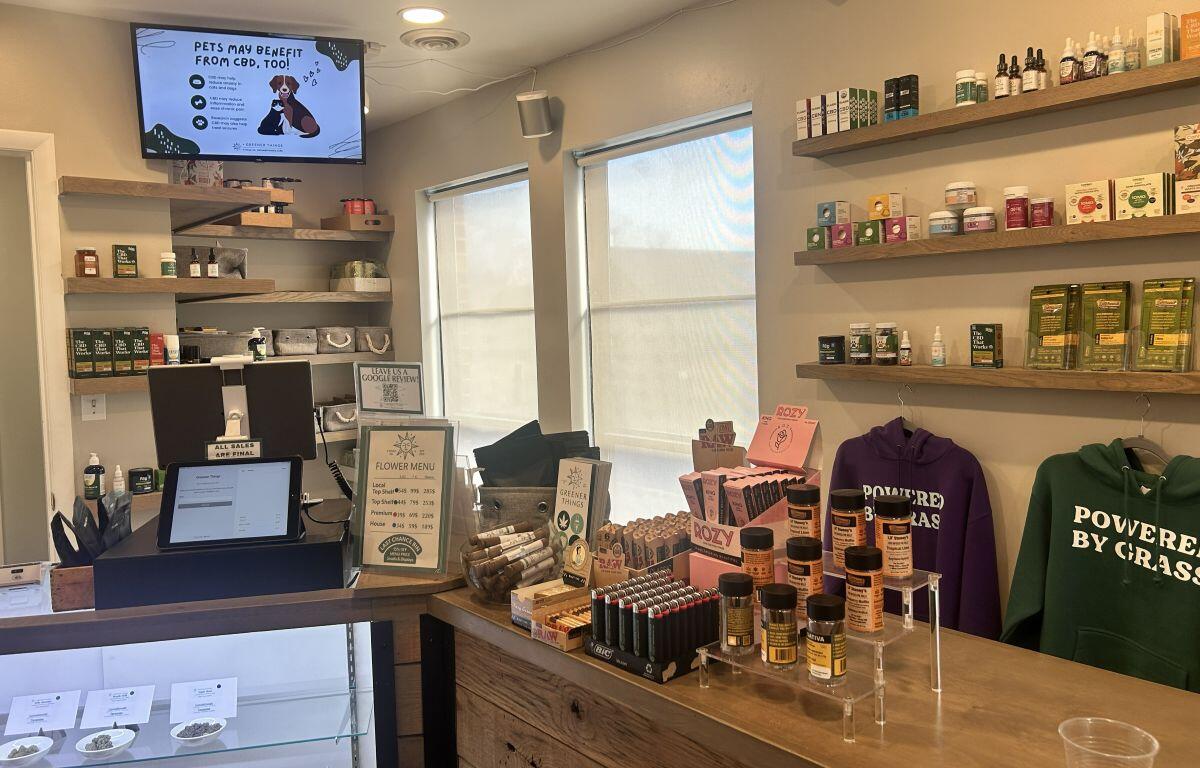
Ross Efaw, co-founder of local CBD dispensary Greener Things, told Cville Right Now he believes “there’s good and there’s bad,” in the current legislation. While he said his two shops are supportive of the safety regulations put in place by the bill, he also wants to ensure that those regulations don’t make harder for shops to sell their products. His fear is that regulations that are too strict could lead to customers trying their luck with non-regulated retailers.
“Things like setback guidelines, packaging requirements, potency limitations – we do believe those need to be in place to a certain degree,” he said. “We just don’t want them to be too restrictive that makes it prohibitive for us to do business, or just is so ineffective, so unappealing to consumers that they just go to the place down the street or go to the pop-up on the weekend and just get whatever they want and risk either consuming something that’s dangerous or harmful or risk legal consequences.”
Efaw shared a similar sentiment about the high tax rate.
“Why would someone pay nearly 20% more for a product that they can just get down the street and not have to deal with that?” he said.
The proposed legislation comes five years after marijuana possession was first legalized in Virginia, but no legal retail market has existed in that time. State Del. Katrina Callsen, who served on the Joint Commission to Oversee the Transition of the Commonwealth into a Cannabis Retail Market, wrote on X in December that 2026 was most likely the year that Commonwealth would establish a legal retail market.
“Right now it is legal to possess, but illegal to buy – allowing for an unregulated illegal market to flourish,” she wrote. “We’ve been meeting as a commission to set up a safe, economically fair, and legal market.”
Morris said she believes there’s “less concern than there should be” among retailers in the area over the new legislation.
“I think a lot of people are just so excited about the idea of recreational cannabis being legalized, they’re failing to look at the repercussions of passing bad bills,” she said. “It’s a whole lot easier to correct the bill before it’s passed than try to make amendments to laws after the fact.”
Outside of running Greener Things’ stores in Charlottesville, Efaw works with lobbying groups and task forces in Richmond. He said he believes some of the legislation being pushed through right now may not have “all the insight involved to make it make sense the way that it should for small businesses.” He said it makes sense to him to delay the start of the retail market so that cultivators and producers have a chance to “get online,” but that does looks like it might not be happening with retail sales expected to begin as early as next year.
“It’s about access that makes sense,” Efaw said. “It’s about structures that make sense and just doing this in a way that allows the market to mature and grow in a natural process.”