


 Listen Live

CHARLOTTESVILLE, VA (CVILLE RIGHT NOW) – Charlottesville City Council Monday night unanimously approved a resolution that could use all the city parks as settings for the public art projects the Jefferson School African American Heritage Center is soliciting using the melted down Robert E. Lee statue that used to stand downtown.
The organization’s “Swords into Plowshare (SIP): Recast/Reclaim Phase 2” is a presentation of “concept drawings by three semi-finalist teams for a project that transforms the material and meaning of the former Lee statue into a new representation of public memory,” according to the organization’s website.
The Council documents included the three artist/designer teams’ visions of the project, all involving multiple city parks.
The specific staff city staff recommendation stated just Market Street and Court Square parks in proposed resolution, but Councilor Michael Payne amended it to include the rest for Council passage.
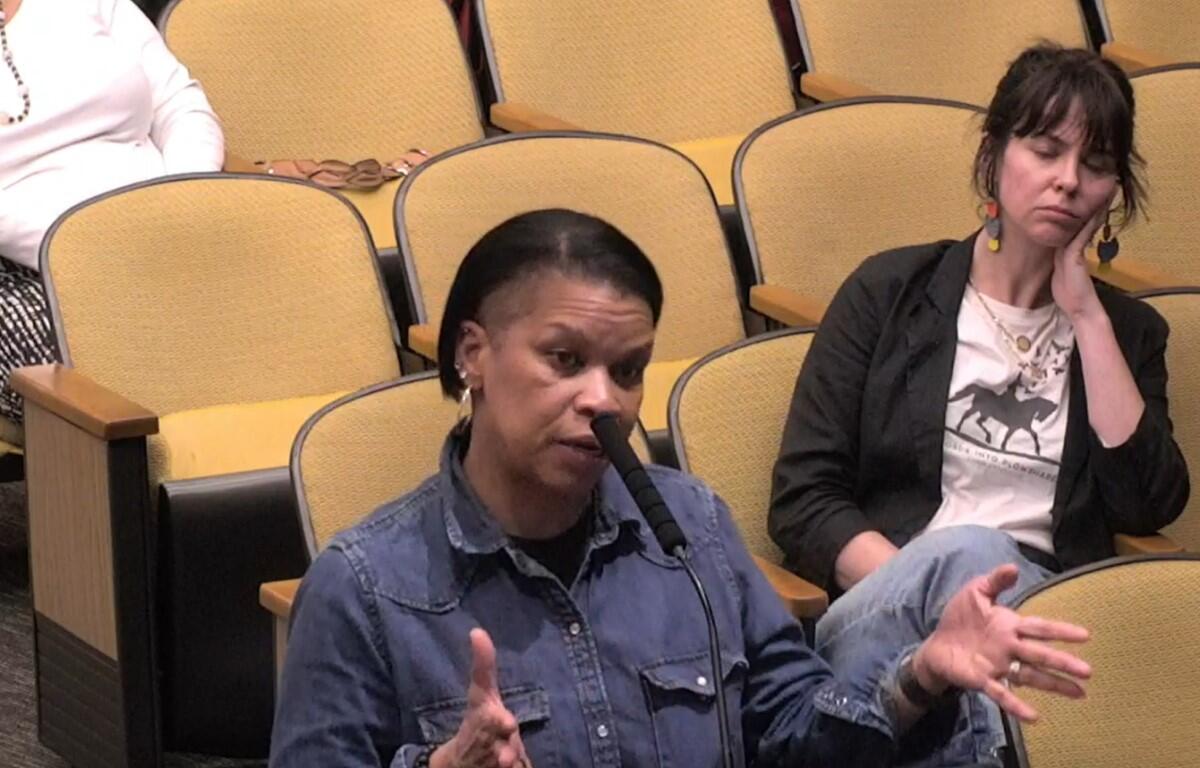
Jefferson School Executive Director Andrea Douglas told Council each of the semifinalist displays include the other parks, “There is the installation that gives you information about how we got there, there is a full description on why we began to highlight the kinds of parks that we highlighted.”
“So, we have available on the website and through all three of the facilities an opportunity to watch a story map about the five parks,” Douglas said. “We originally started with five parks, and it was one of the designers who felt Tonsler Park (needed) to be addressed.”
Part of the reason given including these parks include the stories of Market Street Park once being part of Del. Valentine Southall’s plantation “where he enslaves eight Black people, and later became the home for UVA professor and Lost Cause propagator Charles Venable,” Court Square Park being the location where for 100 years Black people were bought and sold, Washington Park once being part of the Rose Hill plantation where 50 Black people were enslaved and where Paul Goodloe McIntire donated land in 1926 as Charlottesville’s only black park, Belmont Park was once Belle Mont plantation where 27 Black people were enslaved and where McIntire donated land “as a park and playground for white people”, and Forest Hills Park that was Oaklawn plantation where 19 Black people were enslaved and which was created for white people “alongside racially restricted homes.”
Tonsler Park, according to the SIP story, “was built for Black residents atop a former brickyard.”
According to the Council policy briefing, the three semi-finalist proposals are Hood Design Studio, MASS, and PUSH Studio.
The Hood Design proposal “calls for an initial installation at Market Street Park. After some period of display, the installation would be separated out into its component parts and each part relocated to a neighborhood or plantation-based location” with those locations to be identified through a community engagement process.
The MASS design calls for Tonsler Park inclusion.
“This proposal calls for a primary installation in the Market Street Park with the potential for secondary installations in other locations such as Booker T. Washington, Belmont, Forest Hills, and/or Tonsler parks.”
The PUSH Studio design “includes sculptural pieces at six park locations: Market Street, Court Square, Booker T. Washington, Tonsler, Forest Hills, and Belmont”.
Douglas said, “Most of what we have been working on is what we have been calling community awareness, and so trying to bring people to a place where they have the full spectrum of the issues that led us to the place where we were thinking of taking (the Confederate statues) down, then a discussion of where we are now, and ultimately by the time we begin a community engagement process we will hope to have brought the greatest number of people to the understanding of all of our reasoning in that.”
Douglas explained there is a vote being taken “and there are multiple ways to get involved in that.”
She said a community member can go to the Jefferson School exhibition and cast a ballot there, go online to cast a ballot there, and they’ve created a handout that mimics everything on the website to give to people who go to the exhibition and are not ready to vote then. There a QR code to scan when the recipient is ready to vote.
This vote is advisory, and a Jefferson School panel will discuss with city staff.
Deputy City Manager James Freas told Council, “Their next step is they’re going to finalize down to one design team, and then we’re going to begin a process of meeting with staff, and we’re going essentially to do it in the similar way we do design review processes with development projects.”
“That’s going to be a technical review, staff isn’t going to be judging these in any artistic sense,” Freas said.
Freas mentioned the main reason Swords to Plowshares was going before Council Monday night was to get the endorsement that Council was okay “with scale as presented as the project moves forward before they go into more detailed design work.”
City Councilor Lloyd Snook was not completely sold on the concept of the multiple parks, although he was part of unanimous vote to include them all.
He admittedly had not been to the Jefferson School exhibit, though he said he will be going.
“My gut feeling is I’m concerned about the proposals that would have pieces of a larger thing scattered around the city in ways that might make them seem almost trivial in those locations,” he said. “The design that appealed to me most was the one of the schematic representations of the baobab tree in Market Street Park, and I’m not clear on how I’m likely to react to having things sort of scattered around at the other places.”
But Snook qualified it’s an issue he’ll deal with in greater detail after he learns more and the design gets “worked out in greater detail”.
Payne said, “I think this is a huge positive opportunity for the city after the removal of the Confederate statues to not just replace it with nothing and have them be public spaces that can be any public space in the entire country.”
“I think it’s an enormous positive opportunity for the city that I think city government should embrace, and I’m fully supportive of the resolution in front of us that allows the flexibility of accepting whichever project is chosen in numerous park locations.”
As for the policy briefing on that subject, “At this point in time, staff do not have any technical concerns arising from park operations that would suggest any of the proposed parks could not host a component of the Swords Into Plowshares project. Staff across multiple departments will have the opportunity to meet with the selected artist/design team to discuss the specifics of each design and work through design details and logistics beginning shortly after the selection process is complete.”
Douglas said the next step is community engagement which they’re still working on receiving funds for which will be financed entirely from private donations.