


 Listen Live
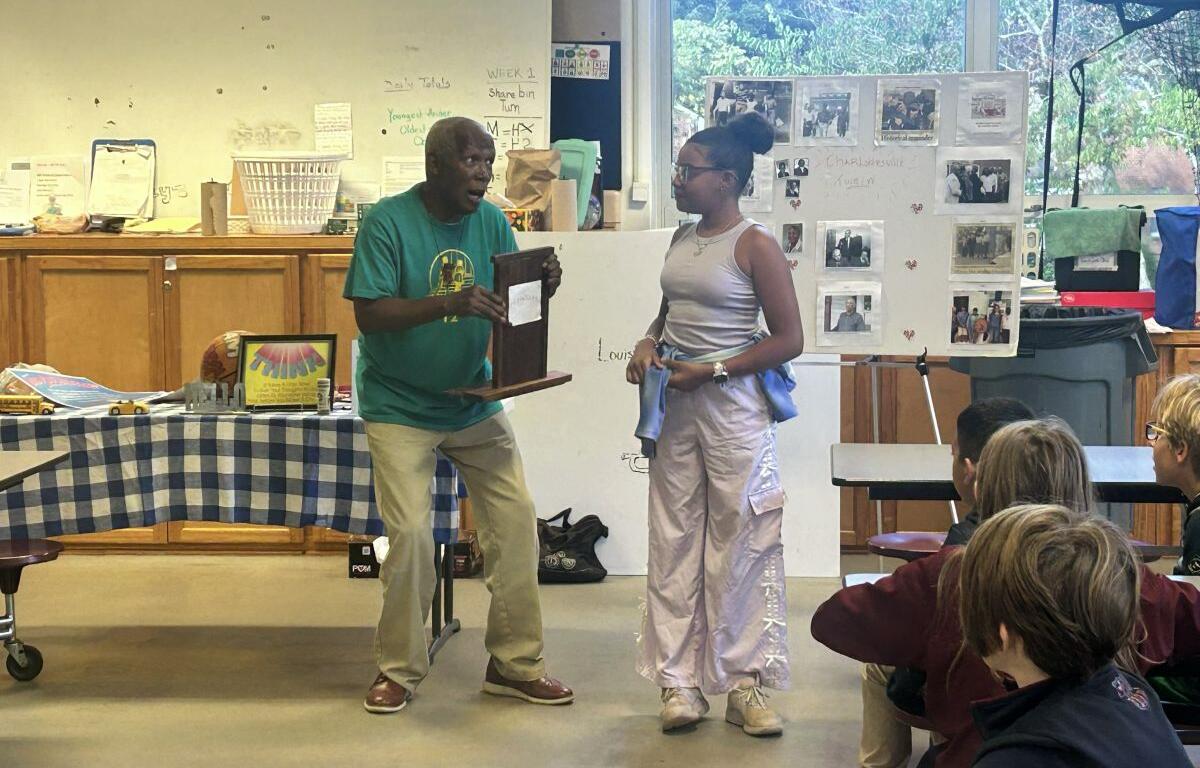

CHARLOTTESVILLE, VA (CVILLE RIGHT NOW) – 67 years after 12 Black students first integrated Charlottesville schools, one of those students, Charles Alexander, came to Sunrise Elementary to speak with its fifth graders about his experiences on Tuesday, the date recognized by CCS as “Charlottesville 12 Day.”
Alexander, also known as Alex-Zan, first began attending Venable, now Trailblazer, Elementary in 1959, one year before Ruby Bridges would gain national notoriety as the first Black student to attend an all-White elementary school in the South.
Alexander was the youngest member of what is now known as the Charlottesville 12, and at the time, had no idea the impact of what he was doing.
“I had a brother that was a couple years older than me. He went to the all-Black school, which is (the Jefferson School),” Alexander told the media afterward. “So, I asked my mom, ‘How come he didn’t go to Venable?’ And she said he didn’t want to, so that answered that right there. You didn’t question Mom.”
It was, after all, his mother’s choice for her son to attend Venable. While Virginia schools were officially desegregated in 1959, only small groups of Black students were admitted at first. Alexander said the local NAACP chapter surveyed families ahead of the school year to see who might be interested in taking this courageous step.
“I lived on 11th Street, so I could look at Venable (Elementary) School from my backyard,” Alexander said. “So, my mom thought that this neighborhood school, that she thought it would be best education for me to go to Venable. So, her and the other parents, they made the conscious choice. That’s why I said they are the heroes. They’re the courageous ones.”
Alexander’s mother is now the last surviving parent of the Charlottesville 12, and Alexander himself is one of nine surviving members of the group, which formally formed in 2009.
Aside from being the youngest, Alexander also holds the distinction of being the only one still residing in Charlottesville.
Alexander has made a career out of giving presentations and programs to schools all across the country, and he made sure to share many of his usual messages about kindness and empowerment with the Sunrise students on Tuesday. But he also made sure to include the historical context of why he was there, using it to inspire the students as well.
“What I try to do is give them a historical perspective on the Charlottesville 12, but also transition into how you can become a history-making trailblazer,” he said.
All in all, Alexander’s messages and stories resonated with students. Fifth grader Abigail Kannauff told the media afterward it was “kind of crazy” to meet someone who was alive during the integration of schools. In particular, she highlighted his message that matters is the “goodness” inside people, rather than the color of their skin.
“I remember learning about segregation, and I thought that was a bit crazy because, as he said … it’s just a skin color, and it doesn’t really matter that much,” she said.