


 Listen Live
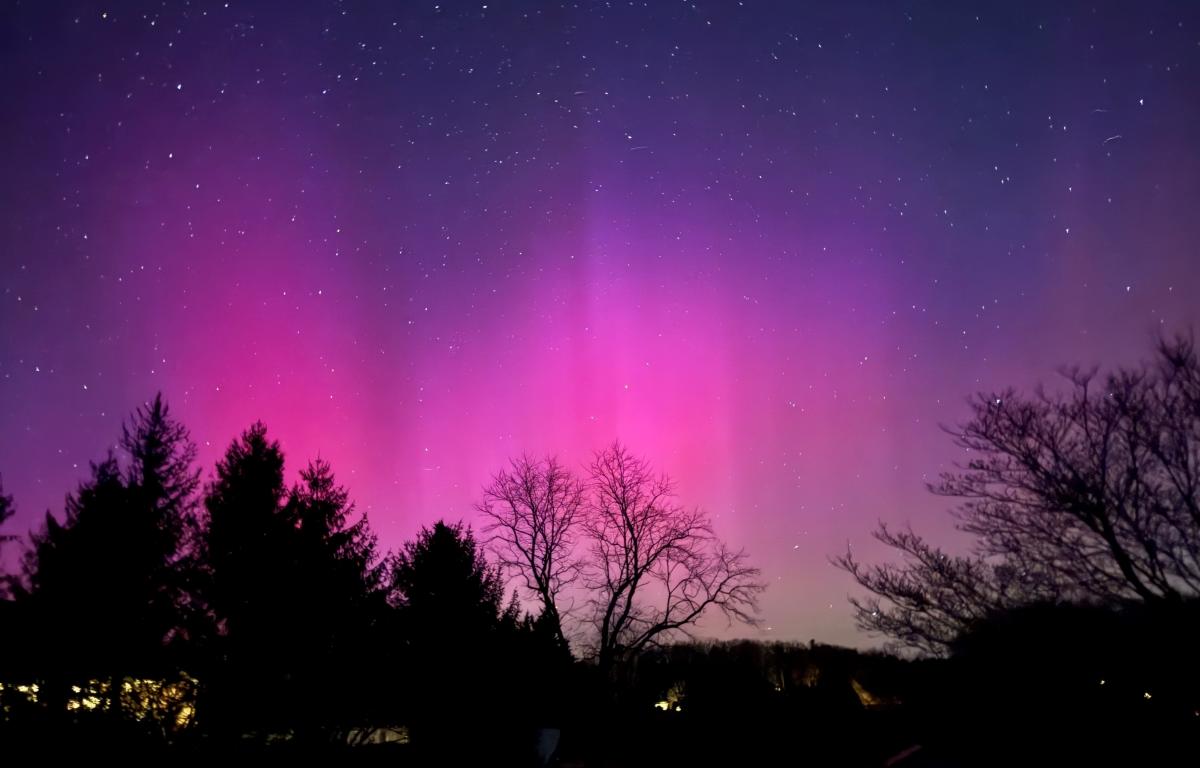

CHARLOTTESVILLE, VA (CVILLE RIGHT NOW) — Over the past few years, Central Virginia has occasionally caught glimpses of a spectacle rarely ever visibly this far South — aurora borealis.
Also known as the northern lights, auroras are the result of sun storms releasing energy that interacts with the Earth’s atmosphere. While auroras are most visible closer to the Earth’s magnetic poles. If a storm is powerful enough and hits the Earth at just the right time and at the right orientation, the northern lights can be visible as far south as Virginia.
However, when that does happen, it’s typically not the auroras most people expect.
“Usually when we see them, what we see are sort of the red colored auroras rather than the most classic ones, which are those sort of green curtains that sweep through the sky,” UVA Department of Astronomy Assistant Professor Matthew Pryal told Cville Right Now. “Those are the ones that are typically more visible in the north latitudes, and the reason for that has to do with the height where these lights are actually being emitted from the atmosphere. And so, in the case of the red auroras, those are happening highest up in the atmosphere, which means you can just see them from farthest South.”
The result is a red cloud hue from the North, and it’s a sight that, while still fairly rare, has become more frequent in Virginia as of late. That’s because the sun reached the peak of its 11-year solar cycle in late 2024, and as a result, more powerful auroras have appeared over the past few years and will likely continue, even as the cycle begins to tail off.
“For the next year or so, there probably should be a couple more flares that give us the potential, if everything stacks up,” Pryal said. “But then the following year, [it’s] going to be even less likely than that and so on until about 2030.”
While Pryal said it’s not impossible for an aurora to be visible when the sun is not at the peak of its cycle, it’s much less likely, meaning now is the time to try and seek out auroras in Virginia. Pryal said he tracks auroras using the National Oceanic and Atmosphere Administration’s Space Weather Prediction Center, which provides a 30-minute forecast of aurora borealis and where it will be visible up to two nights ahead of time.
For those looking to photograph an aurora, some professional photographers say that today’s smart phones are capable of getting the job done. Iceland-based outdoorsman and photographer Jan Dančák explained how in an interview with AmateurPhotographer.com.
‘Newer iPhones (14 and up) – and Android flagship phones – handle low light very well,” he said. “Here’s how to set it up: disable the flash, enable Night mode, and use the longest exposure time available. Hold your phone steady or, better yet, place it on a tripod and set a timer to avoid shaking the shot. For best results, use the primary lens, not the ultra-wide.”
Dančák also said finding the darkest areas possible, similar to those used for stargazing, will help make auroras much more visible, and that it’s best to get set up before it gets dark, as some auroras hit early in the night.
Still, plenty of factors can lead to even the most powerful auroras being hard to see, like if the aurora hits during the daytime or where most of the energy will hit the Earth’s atmosphere. But while the chances of seeing an aurora may be up in the air most nights, Pryal said he personally thinks it’s also worth it to try.
“Even if you don’t see the auroras tonight,” he said, “it’ll be very beautiful to go stargazing regardless, so people should be looking up regardless.”