


 Listen Live
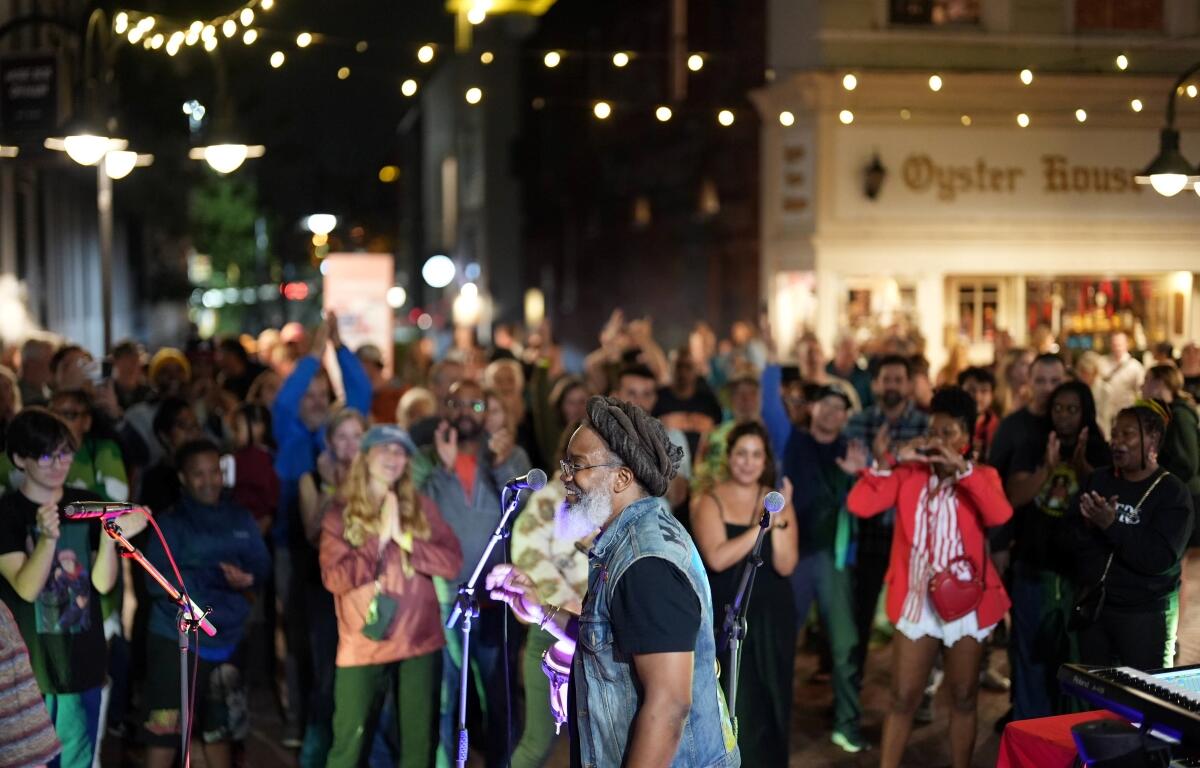

CHARLOTTESVILLE, VA (CVILLE RIGHT NOW) – Less than two days removed from the 14th annual Tom Tom Festival, organizer and founder Paul Beyer already had his mind on next year’s event.
“I’m kind of just diving into what the collective consciousness is around a prevailing theme for the 2027 festival,” Beyer told Cville Right Now on Tuesday.
The 2026 theme was “courage,” for the event that started April 22 and ended Sunday.
“We chose courage because it was the 250th anniversary of the nation, and the 50th anniversary of the downtown mall,” Beyer said. “And it felt like a moment to collectively think about the brave conversations and bold actions that need to happen for the community to move forward.”
This year’s festival included more than 200 events spread over five days, with 400 artists and speakers featured and over 25,800 attendees, Beyer said.
“It focused on optimism and positive visioning, and a sensibility that you have to bring people together from all walks of life in order to have a future that’s actually resonant for a region,” he said. “People from everything from affordable housing advocates to criminal justice reform advocates to advocates for technology and investment, they all have a space at the festival to share what they think the future should be.”
Before the pandemic, the Tom Tom Foundation, the non-profit organization that runs the festival, had a budget of $1.3 million. This year, Beyer and his team worked with under $600,000.
“Since the pandemic, the foundation has lost money every year,” Beyer said. “So we’re trying to figure that out presently. We have a lot of good sponsorships, but it also costs a lot of money to do it. And so, we’re still kind of noodling on this business model that allows this to continue.”
Beyer worked with a team of seven part-timers and a huge coalition of community partners and sponsors to put on the festival.
The Civic Futures Summit was “a coalition-based think tank that brought together leaders from across the community to think about multi-sector ways to advance the region,” Beyer said.
This year’s festival also included a two-day innovation summit.
Holding a festival of this size in an urban area presents a unique set of challenges, but being in downtown Charlottesville is what makes Tom Tom what it is, Beyer said.
“The difference between us doing this in downtown Charlottesville versus a festival doing this in a field somewhere is that, when we’re hosting it, we’re working with Charlottesville police, we’re working with dozens of restaurants and bars, all of whom are bringing their own staff,” Beyer said. “So it really is the type of thing where we create a little nucleus of people helping and kind of organizing Tom Tom and then leveraging 100s of other community organizations to put the festival on.”
Police Chief Michael Kochis said the department had about 50 officers working the festival over the weekend “to keep that event safe.”
“A lot goes into those events behind the scenes,” Kochis said.
Kochis said the department prepared in the weeks leading up to the festival for “worst case scenarios,” but the weekend went smoothly.
Kochis called the event “a success” from a public safety standpoint.
“I think people wanted to go there and have a good time. They did,” Kochis said. “We put a lot of work in. A lot of resources.”
The one issue that arose during the weekend came when a pop-up DJ was shutdown by CPD on Saturday night, according to videos circulating on social media. Details surrounding that incident were unclear.
“I actually don’t know that much about it yet,” Beyer said. “I need to look into it more. What I do know is that the Tom Tom block party ends at 9 p.m. and then we encourage restaurants on the mall to host after parties. I’d heard that there was someone that showed up to perform and was shut down.”
Beyer said having the right level of policing at a festival like Tom Tom can be a tricky balance.
“We really appreciate the tremendous amount of coordination and professionalism that the city of Charlottesville provides the police, fire and rescue, and then overall emergency services personnel,” Beyer said. “Obviously, there needs to be enough of a security presence that people feel safe. But then, if it is too much of a presence or too visible, then that can actually create the opposite effect of people feeling like they’re not safe because, ‘What’s going on?’ So, that’s been an active conversation with the city to just figure out that right level of visibility.”