


 Listen Live
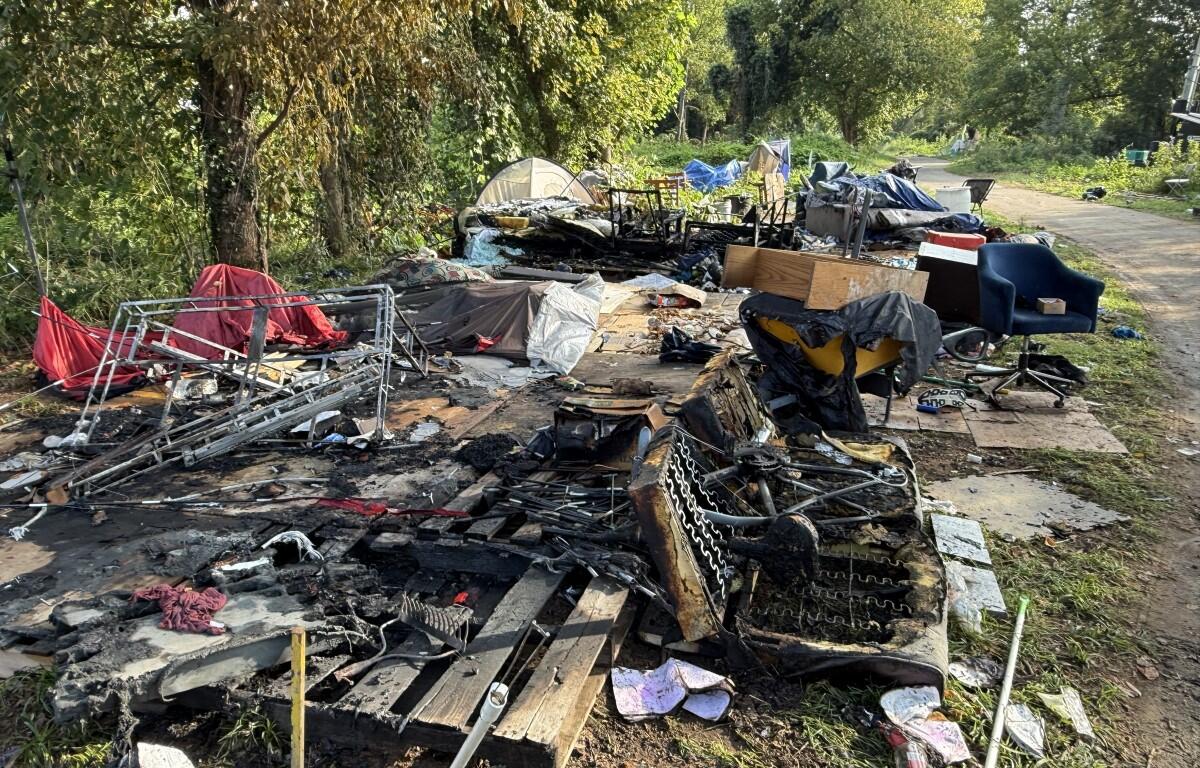

CHARLOTTESVILLE, VA (CVILLE RIGHT NOW) – A pair of fires burned tents at the Free Bridge homeless encampment Wednesday night.
City officials cleared residents from the encampment along the Rivanna River Trail on Tuesday, but many tents and other personal belongings still remain.
Charlottesville City Spokesperson Afton Schneider confirmed to Cville Right Now that both the Charlottesville Police and Fire Departments responded to the fires and the incident is being investigated by the fire marshal’s office.
A person who told Cville Right Now on Thursday morning that they witnessed the fires burning estimated they occurred at about 11 p.m. Wednesday. That would have been about two hours after city officials and staff left the area, City Councilor Jen Fleisher told Cville Right Now.
One fire, about 100 yards east of the Free Bridge, burned a pair of tents and scorched nearby trees. Another fire scene was about 100 feet further east, where a pile of encampment debris had been stacked and set on fire.
The city has contracted with Signature Property Maintenance to clear remaining tents and items from the Free Bridge encampment. That work is expected to be finished by Friday morning. An encampment at 0 East High was cleared Monday night, Fleisher said.
Owner Chad Baber was at the site Thursday morning, using a tractor to push large piles of debris into a trailer to be transported to the Ivy landfill. Some work, however, he said requires more individual attention, including needles or propane tanks.
“When we come across hazardous materials, we take care of that in a different way by isolating it away from the general debris,” Baber said. “We’ve run across a lot of propane tanks that we have to handle this way, and we have boxes to place sharps in when we’ve run across them.”
Baber said the goal is to return the Rivanna River Trail to the condition it was in before the encampment ballooned in size over the past year.
“We’ll clear the large stuff away, then comb through the vegetation to clean up what might be hidden in there,” he said. “We’ll put this trail in the condition where the community can safely use it.”
City officials said 26 people have moved into the new shelter since it opened Tuesday at 2000 Holiday Dr. Fleisher said the city communicated with residents to determine what materials they wanted to keep or have the city store, and what could be discarded. Fleisher said that work even included reaching out to residents who were presently incarcerated but planned to return to the encampment following their release.
Fleisher said she was pleased with how the work went Tuesday and Wednesday relocating people and clearing the residents from the encampment.
“I think it went really smoothly,” Fleisher said. “We got everyone off the trail safely. We were able to transport folks where they wanted to go.”
Fleisher said the presence of activists at the site slowed down the progress.
“Those interactions slowed us down a little bit, but speed wasn’t our goal,” Fleisher said. “It was a really safe and holistic transition.”
Isis Neumann, a community advocate who volunteers with the Care Bears group, criticized the city’s approach at the encampment.
“I don’t personally ever support encampment sweeps but even if you are the kind of person who does, this was just done so poorly from the beginning,” Neumann told Cville Right Now in a text message Thursday. “They started off with no trust or rapport with anyone down there and never did anything to build it. They had strangers come down and ask people about if they were abused and what their private information is and told them they wouldn’t get housing if they didn’t answer all the invasive questions.”
Fleisher disputed that assertion, saying teams including the city’s Home to Hope team spent the past two months meeting and speaking with residents at the encampment. She credited that legwork with Tuesday’s incident-free transition. Fleisher said that the city believes the encampment estimated less than 50 people were living at the encampments by July.
Fleisher said the city aided some encampment residents in moving to other localities or to family member’s residences.
“I think we did our best to communicate at a very deep and broad level,” Fleisher said.