


 Listen Live
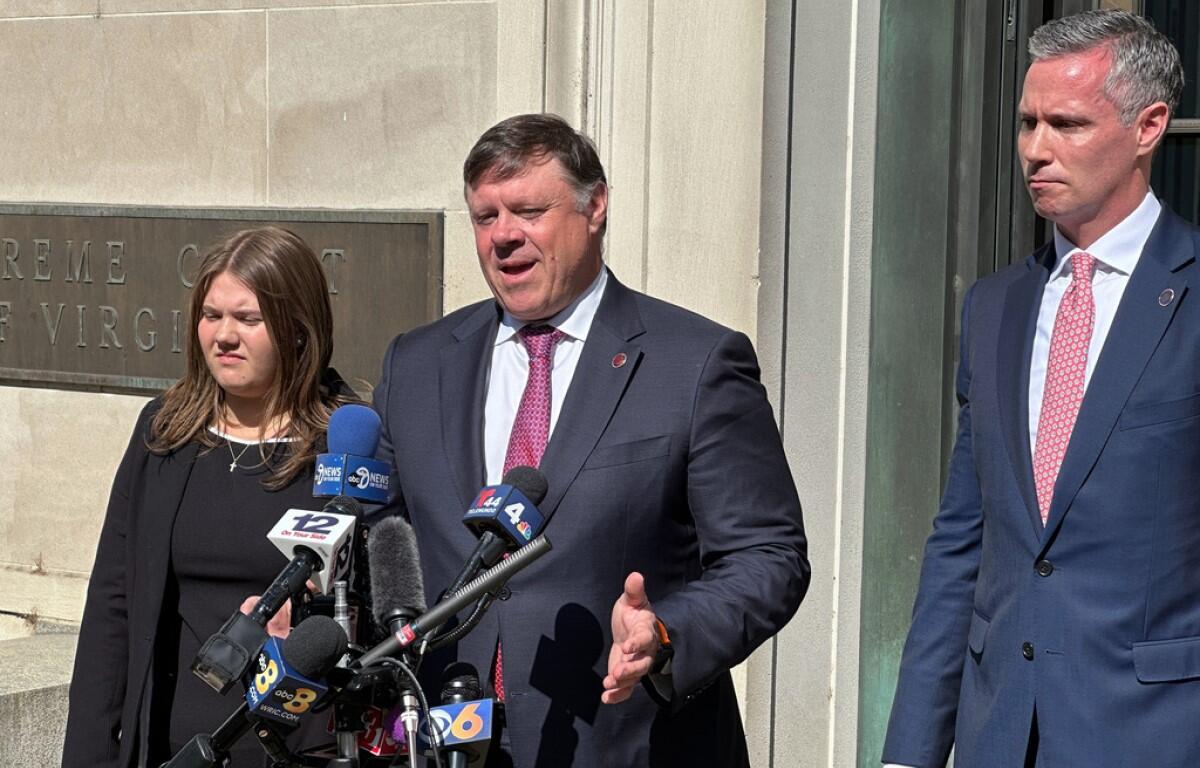

CHARLOTTESVILLE, VA (CVILLE RIGHT NOW) – Two of the seven justices dominated the questioning Monday, expressing skepticism at the claims made by Democratic representatives, as the first hearing regarding the recent redistricting referendum began Monday before the Supreme Court of Virginia.
Attorneys for both sides made their opening arguments in the case filed by Senate Minority Leader Ryan McDougle (R-Hanover) to stop the redistricting amendment, which was passed by voters in last week’s referendum.
Justices Stephen McCullough and Wesley Russell questioned both sides, casting doubt on appellant attorney Matthew Seligman’s arguments.
Seligman was doing oral arguments for Nardo et al in appealing a Tazewell County Circuit Court’s injunction that attempted to stop last Tuesday’s referendum.
Thomas McCarthy argued for McDougle et al, who filed the first lawsuit after the General Assembly passed the constitutional amendment that allowed the new map to be submitted for voter approval. The map is expected to give Democrats a 10-1 advantage in Virginia’s delegation to the House of Representatives.
Arguments revolved around whether Democrats followed Article 12 of the Virginia Constitution about amending the document, which states the General Assembly must pass the amendment, followed by an intervening general election. Then the newly elected General Assembly must pass the amendment again before it can finally be ratified by the voters.
Because a special session met in October after early voting had started for the Nov. 4 election, Republicans argued the provision to have the General Assembly pass the amendment while early voting was occurring violated the intervening election requirement.
“Webster’s, Oxford, Black’s Law, they all define election to mean the entire process by which votes are cast to determine a winning candidate,” McCarthy argued.
“Federal law defines the election as the day of the Tuesday after the first Monday in November,” Seligman said, “and this goes back to 1872 when they defined the election as that day as the day for the election. The federal cases are unanimous on this.”
“It’s the people, the people of the Commonwealth, the voters, who possess (the power) to amend or modify the Constitution,” McCarthy argued.
He argued that it was because of this, the Tazewell Court was right to be concerned about a provision inserted into the Constitution in 1902 about publication of a proposed amendment, which must be posted for 90 days after it was passed. This was partially removed from the Constitution in 1971.
“Denying them the knowledge that this proposed amendment was coming through undermines the whole process,” McCarthy said.
“The people did, in fact, validly ratify the proposed amendment last Tuesday,” Seligman insisted.
Monday’s arguments were in a part of a special session, as the April session was held last week and its next session of arguments won’t start until June 8
Though it’s not known when the court will issue its ruling, the party candidate filing deadline for the August 4 primary is May 26.
The General Assembly this past winter moved that primary date from June 16 to August 4 in light of the April 21 balloting.