


 Listen Live
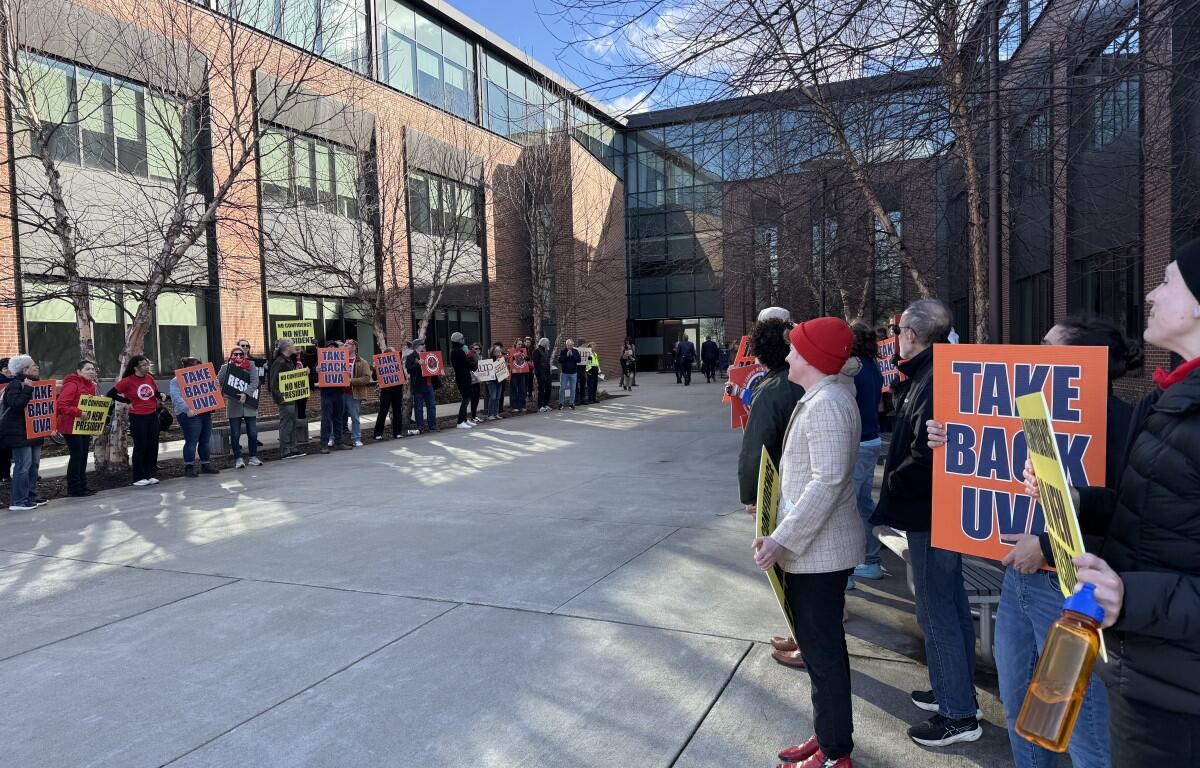

CHARLOTTESVILLE, VA (CVILLE RIGHT NOW) – As public workers’ collective bargaining legislation sits on Gov. Abigail Spanberger’s desk, faculty, campus staff, and graduate workers from Virginia public universities are urging her to add all university workers to the bill before she signs it.
The bill, as it passed out of the General Assembly, does not include higher ed workers who are not included in the definition of “service employee.”
“It’s about time that our commitment is honored by restoring collective bargaining rights to everyone in higher ed, including the professors, including the grad workers and staff that don’t fit under this narrow definition,” said University of Virginia recycling worker Andrew Gneiting, a member of the United Campus Workers UVA Chapter during an online rally Wednesday. “I used to feel very separate from any sort of class instructors like professors and grad workers, but when I joined the Living Wage Campaign my expectations were blown out of the water and organizing put us in the same room together, put us at the same table together to work towards a common goal.
“I also know we need a fair and democratic workplace in order to provide the best education of students, in order to be a good neighbor to Charlottesville and Albemarle County, and in order to raise the standards we have for institutions of higher education.”
The legislation amending the Virginia Code pertaining to Labor and Employment includes “employees of a public institution of higher education except for service employees.”
The legislation defines the service employees as “an employee employed at least 16 hours per week at a public institution of higher education performing work in connection with the care or maintenance of property, including a janitor, security officer, groundskeeper, concierge, clerical and administrative assistant, door staff, maintenance technician, handyman, superintendent, elevator operator, window cleaner, building engineer, or food preparation services worker.”
“Tenure is supposed to be about the right to teach and research and produce knowledge regardless of political control,” said Walt Heinicke, a tenured associate professor at the University of Virginia and past chair the university chapter of the American Association of University Professors. “College and universities are not administered as people think as they are increasingly more top-down in management, subject to political interference, and tenure is no longer what it was.
“Many tenured faculty don’t feel they have a voice in authentic shared governance, many are afraid to speak out in fear of retaliation, and this undermines academic freedom.”
Heinicke asserted that tenured faculty are being fired around the nation, including five at Virginia State University back in December, without cause and without due process.
“The president at UVA, Jim Ryan, probably would not have been ousted if faculty had authentic involvement in governance through collective bargaining, and the selection of a new president would not have been controversial if faculty had collective bargaining rights,” Heinicke said. “The continuing pall over the curriculum we’re experiencing today would have been challenged and would be challenged if we had collective bargaining.”
A 2021 published article in UVA Today said the commonwealth’s long history of hostility toward collective bargaining has its roots in higher education when the General Assembly passed a joint resolution to prohibit state agencies from recognizing public sector unions after Black workers at the University of Virginia’s hospital system tried to organize in the 1940s.
“Faculty working conditions are students’ learning conditions, collective bargaining would enhance this,” Heinicke said.