


 Listen Live
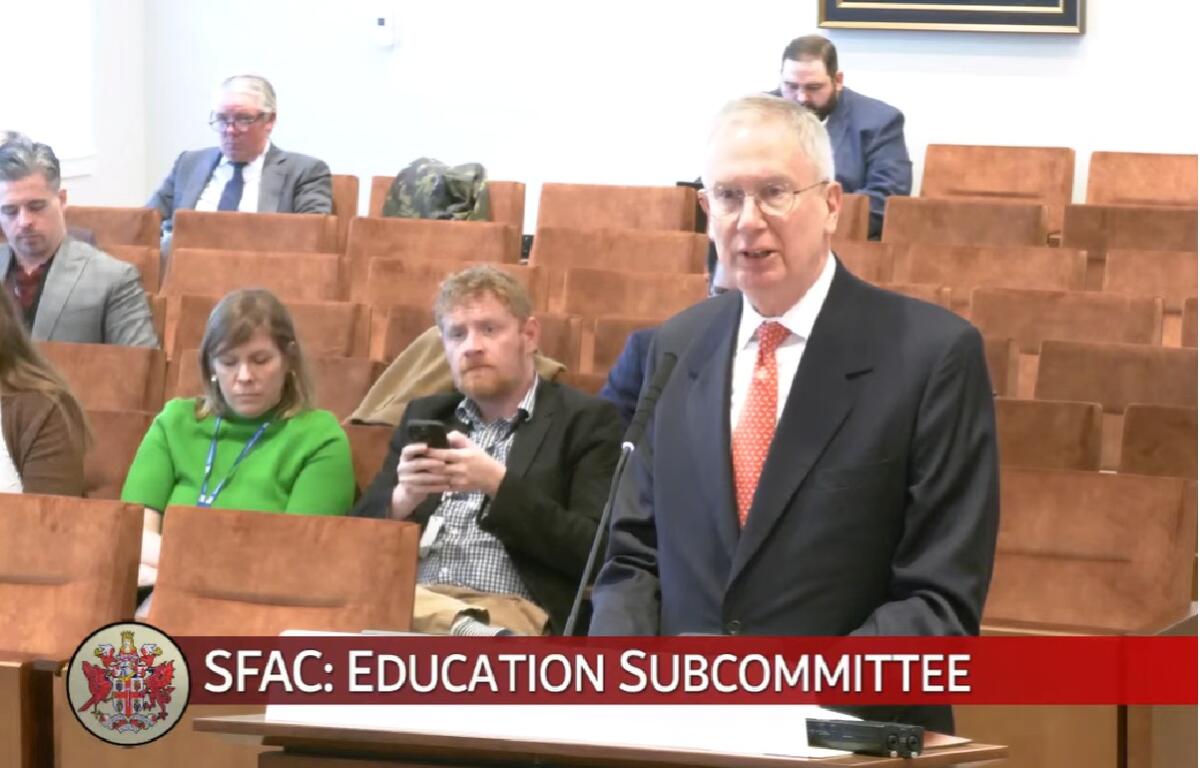

CHARLOTTESVILLE, VA (CVILLE RIGHT NOW) – University of Virginia Interim President Paul Mahoney appeared before the State Senate Financial Education Subcommittee on Monday to offer clarity on where things stand between UVA and the U.S. Department of Justice, and give an update on the search for the university’s next permanent president.
Before taking questions, Mahoney gave a presentation that included what led up to the decision to reject the federal education compact offered to the university back in October by the Trump Administration.
The DOJ had claimed UVA’s diversity, equity, and inclusion (DEI) programs, as well as its admissions and hiring processes, violated federal civil rights laws, and that its campus culture was inhospitable to Jewish students, which led to investigations.
UVA and the Department of Justice (DOJ) reached an agreement under which UVA agrees to comply with civil rights laws and provide quarterly reports on its efforts through Dec. 31, 2028, at which time the government will conclude the investigations. The agreement includes no monetary penalty and no external monitoring.
Some lawmakers, mostly Democrats, alumni and faculty opposed the agreement and said it opened the school up to legal liability conflict with existing law and infringed on state sovereignty. It’s that tension that led the State Senate Financial Education Subcommittee to call Monday’s meeting.
“Waiting for an enforcement action and then litigating would have been potentially devastating to the university’s mission and financial well-being,” Mahoney said. “The sanctions potentially available to the DOJ include immediate suspension or termination of federal research grants, which total approximately $452 million for UVA.”
Another hot button issue was UVA’s search for its next permanent president.
Last month, Gov.-elect Abigail Spanberger, a Democrat, asked UVA leaders to suspend their search until vacant seats on the governing board are filled and confirmed, likely in the upcoming legislative session, which begins in January. Spanberger said the board members “severely undermined” the public’s confidence in their abilities amid the agreement with the DOJ.
Governor Glenn Youngkin, however, said that UVA should not delay its decision and characterized Spanberger’s request as an improper attempt to interfere with the hiring process and an incorrect depiction of board members’ efforts.
“It’s dangerous to wrongfully disparage committed individuals who volunteer to serve on university boards and the serious work they do,” Youngkin wrote in a letter in November. “Further, the governor of the commonwealth should speak thoughtfully and honor the service of those individuals.”
State Senator, and Lieutenant Gov.-elect, Ghazala Hashmi, questioned Mahoney’s current confidence in leadership, including Rector Rachel Sheridan and Vice-Rector Porter Wilkinson, who did not attend the meeting.
“As we know, with the great distress of the last year at the institution, the idea of a presidential search at this moment is fraught with a lot of challenges and difficulties,” Hashmi said. “The first and I think critical one is, I think you are probably not going to see some of the applications that we would see if the situation was not as complex as it is.”
Because the Board of Visitors has the final say in who will become UVA’s next president, Mahoney pledged not to speak on their behalf. However, he did disagree with Hashmi’s assessment, arguing that what would have primarily deterred candidates were the ongoing investigations that are now closed.
“As I can testify from personal experience, one would step into that situation either knowing that you were going to reach an agreement that would make you the target of criticism, or you would potentially not resolve the investigations and face devastating consequences,” Mahoney said. “That particular uncertainty has been taken off the table. The search firm [Isaacson Miller] stated that there was a surge of very high-quality applications right after that agreement was signed.”
Mahoney said that as the search is confidential, he has no way of knowing who is or isn’t a candidate, but that Isaacson Miller is confident that the university has received high quality applications.